

A CPG category manager reviews performance results for the past quarter. Sales are slightly below plan, inventory is higher than expected, and logistics costs have increased. Each number has an explanation. Each explanation comes from a different system. Commercial teams point to weaker-than-expected demand. Supply chain teams highlight forecast errors driven by late retail data. Operations teams refer to production constraints that were not visible at the time decisions were made. All explanations are valid. None of them is complete.
This is how decision-making often looks in the CPG sector. Problems do not stem from a lack of data, but from the fact that data is fragmented across systems, updated at different speeds and interpreted in silos. Decisions are made with partial context, and responsibility is spread across functions that do not operate on the same version of reality.
As CPG organizations scale across markets, channels, and partners, this fragmentation becomes a structural risk. It slows down reactions, amplifies inefficiencies and turns everyday trade-offs into costly surprises. In this environment, data platforms are no longer an analytical convenience, but rather an operating backbone that connects commercial intent with operational execution.
The Data Reality of the CPG Sector
CPG, or Consumer Packaged Goods, operates under conditions that leave little margin for error. High volumes, short product lifecycles and constant promotional pressure require decisions to be made quickly and revised just as quickly. Demand patterns are influenced by seasonality, pricing actions, availability, local market dynamics and external disruptions – situations where a single event, such as the Ever Given blocking the Suez Canal, can ripple through supply chains and distort demand signals far beyond the original incident.
At the same time, the number of data sources continues to grow. Retailers provide sales feeds at different levels of granularity, distributors report with delays, e-commerce channels generate real-time demand signals, and production systems produce operational data that rarely aligns with commercial reporting cycles. Even when data is technically available, it is often incomplete, late or difficult to reconcile across functions.
Why Traditional Analytics No Longer Suffice
In many CPG organizations, analytical environments remain centered around data warehouses and reporting tools. Broader research by BARC shows that 79% of enterprises include a data warehouse in their analytics architecture, and 82% operate multiple architectural types, including data lakes and marts.
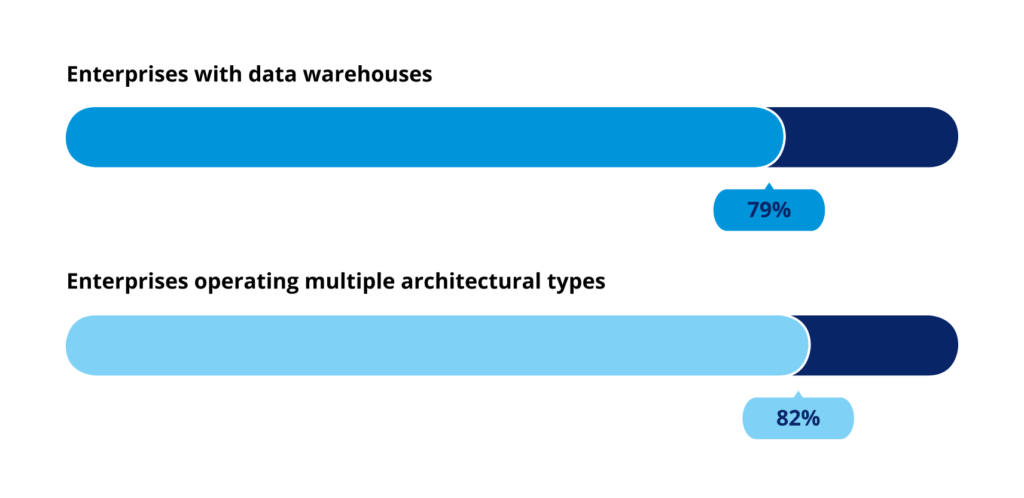
Data warehousing therefore continues to play a foundational role in corporate analytics landscapes. However, such environments are not designed to support decisions that span multiple functions and require rapid response.
Traditional analytics setups rely on periodic refreshes, static data models and predefined reports. Insights are generated after the fact, when the window for corrective action is already narrowing. As operational tempo increases, this delay becomes increasingly costly. Data platforms address this limitation by shifting the analytical focus from retrospective insight to continuous decision support.
What Data Platforms Mean in a CPG Context
A data platform provides an integrated environment that supports the full lifecycle of data, from ingestion and transformation through to analysis and operational use.
In the CPG sector, its defining value lies in connecting commercial, supply chain and operational data into a shared view that reflects the current state of the business. This allows decisions to be evaluated in context, based on consistent assumptions and timely information rather than isolated snapshots.
For example, a promotional decision no longer relies solely on historical uplift models or commercial targets. Commercial teams can assess expected demand alongside current inventory positions, production capacity and logistics constraints. If stock levels are uneven across regions, or lead times are already under pressure, the promotion can be adjusted in scope, timing or channel mix before it creates downstream disruptions.
By sitting above existing systems, data platforms introduce coherence where fragmentation previously shaped decisions, enabling teams to coordinate actions across functions instead of optimizing in isolation.
Core Components of Modern Data Platforms in CPG
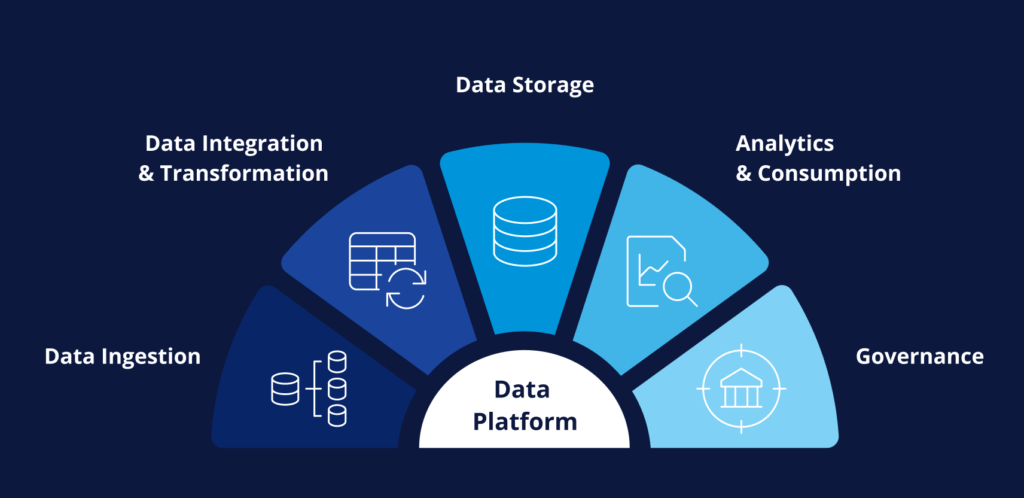
Modern data platforms in CPG are designed to address a specific operational challenge: decisions are made across multiple functions, but the data that informs them arrives through disconnected systems and at different speeds. To support coordinated decision-making, data platforms are built as layered architectures, where each layer plays a distinct role in turning raw inputs into decision-ready information.
Rather than functioning as a single system, a data platform connects multiple capabilities into a coherent structure. This layered approach allows organizations to scale data volume, integrate new sources and adapt analytical use cases without disrupting existing operations.
Core layers of a modern CPG data platform:
Data ingestion
Collects data from ERP systems, point-of-sale feeds, distributor reports, e-commerce platforms and IoT devices across factories, warehouses and transport assets. These sources differ in structure, frequency and reliability, making ingestion a critical foundation for downstream decisions.
Data integration and transformation
standardizes, reconciles and enriches raw inputs across systems. This layer aligns master data, handles late-arriving records and applies quality checks, ensuring that inconsistencies do not propagate into forecasts, reports or operational decisions.
Data storage
Provides scalable, cloud-based storage for both large historical datasets and high-frequency data streams. Elasticity at this layer is essential to support seasonal demand peaks, major promotions and rapid changes in data volume.
Analytics and consumption
Enables reporting, supply chain analytics, demand forecasting and predictive models. This is where data is translated into insights that support everyday decisions across commercial and operational teams.
Governance, security and access control
Ensures data remains trustworthy, compliant and accessible to the right stakeholders. Clear governance at this level underpins confidence in the platform and supports cross-functional use at scale.
Key Use Cases Enabled by Data Platforms
The practical value of data platforms becomes most visible through their impact on everyday operational and commercial decisions.
In demand forecasting, platforms combine historical sales data with near real-time signals from retail and e-commerce channels. This allows planners to detect shifts earlier, evaluate alternative scenarios and adjust production or distribution plans before imbalances grow.
In supply chain analytics, integrated visibility across inventory, transport and production enables faster identification of bottlenecks and risks. Decisions are based on current constraints rather than assumptions derived from outdated reports.
From a commercial perspective, data platforms connect promotions, pricing actions and availability to actual sales outcomes. This supports more accurate evaluation of promotional effectiveness and improves future planning by grounding decisions in consistent, cross-channel data.
Real-Time Data and IoT as Operational Signals
Real-time data plays an increasingly important role in CPG operations. IoT devices continuously generate signals from production lines, storage facilities and logistics assets. When integrated into a data platform, these signals provide early warnings of deviations, quality issues or capacity constraints.

IoT Solutions and Product Tracking in the Life Sciences Industry
Discover how IoT technologies are transforming operational visibility in the life sciences industry. Explore practical insights from our successful pharma projects.
This capability fundamentally changes how organizations respond to disruptions. Instead of explaining issues after they occur, teams can intervene while there is still time to mitigate impact. For example, a drop in production throughput or an unexpected delay in outbound logistics can be detected before it affects service levels, allowing plans to be adjusted across manufacturing, inventory allocation and customer commitments.
At scale, this shift from reactive to anticipatory decision-making represents a significant operational advantage. It reduces the ripple effects of local disruptions and enables organizations to manage trade-offs consciously rather than under pressure.
Omnichannel Retail and Unified Consumer Data
The expansion of omnichannel retail has further increased data complexity. Physical stores, online shops, marketplaces and distributors each generate different demand signals, often with different timing, structure and reliability.
Omnichannel behavior is now mainstream among consumers and economically significant for retailers. Research by Deloitte shows that omnichannel shoppers spend on average 1.5 times more per month than single-channel shoppers. This pattern reflects broader shifts in consumer behavior, as most purchasing journeys now span multiple channels, blurring the distinction between online and offline.
Data platforms allow CPG companies to unify these signals into a consistent view of demand. This unified perspective supports more informed allocation and forecasting decisions: for example, when online sales accelerate while in-store demand softens, or when marketplace orders surge ahead of distributor replenishment cycles. With a shared view of demand across channels, organizations can adjust inventory placement, replenishment priorities and fulfillment strategies before imbalances translate into lost sales or excess stock.
Cloud Computing as an Enabler of Scale and Speed
Cloud computing underpins most modern data platforms in the CPG sector, not only because of scalability, but because it changes how organizations work with uncertainty. Fluctuating data volumes, seasonal demand spikes and increasingly granular data streams are no longer treated as exceptions that require special planning, but as normal operating conditions.
Just as importantly, cloud-based platforms shorten the distance between identifying a decision gap and acting on it. Teams can test new analytical use cases, incorporate additional data sources or refine forecasting models while the business context is still relevant. When priorities shift, for example due to an unexpected demand surge, a supply disruption or a change in channel mix, analytical capabilities can be adapted without waiting for infrastructure changes or long implementation cycles.
In practice, this flexibility translates into faster alignment between commercial intent and operational execution, reducing the lag that often turns manageable variability into structural inefficiency.
The Impact of AI and Predictive Models
AI predictive models are increasingly applied in demand forecasting, anomaly detection and scenario planning. Their value, however, depends less on model sophistication and more on the quality, consistency and timeliness of the data they consume.
Within a data platform, AI operates on a shared and current view of the business rather than fragmented inputs from individual systems. This allows predictive outputs to be evaluated in context, alongside inventory positions, production constraints and channel dynamics, instead of being treated as abstract forecasts. As a result, AI supports judgment by highlighting risks, trade-offs and alternative scenarios, rather than producing isolated recommendations.
This shifts the role of AI from replacing human decision-makers to extending their field of view. When predictive models are embedded in a data platform, they help organizations recognize emerging patterns earlier and act with greater confidence, without surrendering accountability for complex, cross-functional decisions.
Data Migration and Organizational Challenges
Despite their benefits, data platforms are not easy to implement. Many CPG organizations operate complex legacy landscapes shaped by years of incremental system additions, fragmented data ownership and inconsistent definitions across functions. Data reflects how the organization evolved, not how decisions are made today.
In this context, simply migrating existing systems to the cloud rarely delivers meaningful improvement. Without changes in ownership, governance and ways of working, fragmentation is preserved rather than resolved. Successful initiatives therefore combine technical modernization with organizational alignment, establishing clear data ownership, shared definitions and cross-functional collaboration around key decisions the platform is meant to support.
Business Impact and Strategic Value
The business impact of data platforms in the CPG sector should be assessed not through technology features, but through their effect on everyday decision-making. When data is consistently integrated and available across functions, organizations are better positioned to turn information into action rather than after-the-fact explanation.
This perspective aligns with broader research on advanced data analytics, which shows that organizations can convert raw data into actionable insights, improving operational efficiency, reducing risk and supporting more informed decision-making across areas such as forecasting, inventory planning and resource allocation.
In practical terms, this translates into several tangible benefits for CPG organizations:
Faster decision cycles
Shared, up-to-date data reduces the time required to align commercial, supply chain and operations teams, allowing decisions to be made while they can still influence outcomes.
More consistent planning across functions
Common definitions and synchronized data inputs limit contradictory assumptions between demand forecasting, inventory planning and execution.
Reduced inventory risk
Improved visibility into demand signals, stock positions and constraints enables earlier intervention, helping avoid both stockouts and excess inventory.
Improved promotional execution
Promotions can be planned and adjusted with a clear view of availability, capacity and channel dynamics, reducing downstream operational disruptions.
Greater operational resilience
Integrated data supports earlier detection of disruptions and more deliberate management of trade-offs under volatile conditions.
Clearer accountability for decisions
When teams operate on a shared version of reality, responsibility shifts from explaining results after the fact to owning decisions in real time.
The Future of Data Platforms in CPG
Looking ahead, data platforms will continue to evolve toward greater real-time capabilities, deeper automation and closer integration with operational processes. Their role, however, will not be defined by how advanced the technology becomes, but by how effectively it is embedded into everyday decision-making. In the CPG sector, this means moving beyond analytics as a support function and toward data as an integral part of how plans are created, adjusted and executed across functions.
As organizations mature, data platforms increasingly serve as the connective tissue between commercial intent and operational reality. They make it possible to sense changes in demand earlier, understand constraints more clearly and evaluate trade-offs before decisions cascade through supply chains, inventories and customer commitments. Over time, this shifts the organization’s posture from reacting to volatility toward managing it deliberately.
Ultimately, the strategic value of data platforms lies in how they reshape responsibility. When decisions are grounded in shared, timely context, accountability becomes clearer and coordination more natural. In a sector defined by speed, scale and constant trade-offs, data platforms increasingly determine whether organizations spend their time explaining outcomes after the fact , or actively shaping them while there is still room to act.
FAQ
What is a data platform in CPG?
A data platform in CPG is the shared foundation that collects, integrates, governs, and makes data usable across teams and systems. It brings together signals from ERP, point-of-sale, distributors, e-commerce, supply chain, and IoT sources so organizations can analyze performance consistently and act faster.
How do data platforms improve demand forecasting and promotions in CPG?
By unifying sales, inventory, pricing, and promotional data across channels and partners, data platforms reduce blind spots and conflicting reports. This enables more frequent forecast updates, better promo lift measurement, and faster course corrections when demand shifts during a campaign.
What is the difference between a data warehouse and a data platform in CPG?
A data warehouse is typically the centralized repository for curated, analytics-ready data. A data platform is broader: it includes ingestion, integration, governance, security, and consumption layers, plus the warehouse or lakehouse components that support multiple use cases such as forecasting, omnichannel analytics, and real-time operational monitoring.
Would you like more information about this topic?
Complete the form below.