
AI Agents Implementation: Autonomy, Architecture, and Ethics

Watch the episode
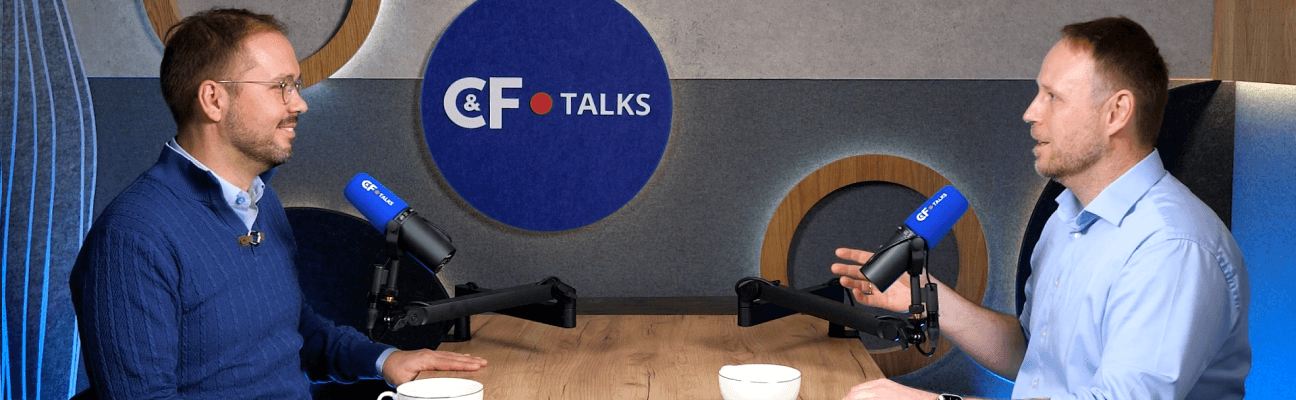
Maciej Kłodaś [MK]
Hi everyone, my name is Maciej, I’m the leader of Analytics Experience Competency Group, and this is C&F Talks, a place where experts discuss the challenges and trends from the perspective of an IT partner. As always, I encourage you to leave some comments, likes, and tell us if you like our content, what you’d like to see next.
And today my guest is Marcin Ludzia, head of AI technology practice at C&F. Hello Marcin.
Marcin Ludzia [ML]
Hello Maciek, it’s great to be here.
[MK]
I love the topic that we will be discussing today, agentic AI, which is a very hot topic right now, there’s a lot of hype on the market.
So tell me Marcin, since we have a very, very big hype for agentic AI or agents or AI in general, in what we see in projects with our clients, but also what we see is that this is a very chaotic process. There is a lot of budget flowing in companies towards AI projects, but since there is no structured process for it, there is no clear vision for the value. We see that people are investing in agenting AI without knowing what is their real purpose and what value it will bring.
[ML]
As you said, agentic AI or AI agents right now is a very, very hot topic. And there is a reason for that because AI agents are perceived as a future and most valuable application of current and future AI technologies. But because it is so hot topic right now, it is also, as you put it, a lot of chaotic information in the space.
Also, there are random approaches to the projects which doesn’t help. You need to actually know how to approach those types of projects and how to generate business value from applications of agents. So if we would like to discuss those type of projects, those type of applications of AI technology, we should start from definition of what an AI agent is.
[MK]
Everybody is defining it differently. Everybody is calling AI agents everything that we are currently implementing. So chatbots and things like that are called agents instead of something else.
[ML]
Yes, that’s true. Yes. To some extent, everybody is calling agents everything that connects with AI currently.
However, term agent and especially intelligent agent has a much broader history in AI space. So the intelligent agent actually was coined in 1990s, so around 30 years ago. And the original definition that is also applicable today is that an agent is a piece of software that can sense data or can sense inputs from the environment, reason based on those data, and execute some actions based on decisions or based on some plan of action from those inputs.
So this is the original definition that is also applicable today. Another point in this definition is that agents are autonomous. But this also needs to be clarified.
It’s not as many people think. Agents don’t have consciousness and agents don’t have free will to operate. The autonomy of agents means that agents can operate on their own based on inputs from the environment. So they don’t need to be pushed by humans. They don’t need to wait for human input, but they can actually independently operate based on constant inputs from the environment.
[MK]
Okay. So the key expression here would be the decision making, because we can have so-called agents and this is something that is very commonly called when we deliver some projects like that. They are called agents instead of being called assistants, because you need to guide this agent toward any kind of task, right?
So you need to have you as a human need to input any kind of information or request to this agent, instead of agent being able to decide on its own what to do next based on certain criteria.
[ML]
Yes. The real differentiation between assistants and agents is this autonomy. The decision making capability is one of the main, as you mentioned, main capabilities of agents, but not the only one.
Assistants, so the common chatbots that are implemented in many companies right now, especially knowledge management assistants to manage knowledge internally in companies or chatbots that provide data based on user input from the database. Those are assistants that act when user prompts them. Agents would be a different piece of software that can act constantly based on some inputs that arise.
[MK]
The trigger.
[ML]
The trigger, exactly. So you can, for example, imagine an agent that can trigger when a customer sends a complaint to the company and this agent can be designed to, to make sure that this complaint is properly handled. So depending on the level of autonomy that we give to this, to this agent, and this comes from the business rules of the company, this agent can potentially solve the complaint on its own, or for example, analyze the complaint, classify this complaint, suggest the way to handle it, and then create a complaint ticket in the system so that a human employee that is responsible for answering those customer complaints can read the whole complaint, read the suggested response and act on their own. But the AI agent can simplify this analysis and make the whole process much faster.
So this is just a simple example.
[MK]
Knowing that there is this hype and companies try to implement as many AI tools, because they obviously have KPIs for that from above, what are the types of agents or what an agent can help with when you think of such implementation? It can be an assistant. It can be something that will analyze the input, as you said, from complaints and take action, categorize, and then decide whether to accept the complaint or not. What are other possible use cases where we can utilize such technology?
[ML]
So there are multiple typologies of AI agents. The one I like to use actually, actually classifies agents into four categories. So the first type of, of agent, sometimes this category overlaps a little bit with, with assistants is a type of agents that actually provide some information, relevant information to the situation.
So this customer complaint agent that we just discussed is one of example of such an agent. Another example would be an agent that can provide information for the support team on how to solve a certain problem within the IT environment. So based on some knowledge base, articles from the internal infrastructure of the company, this agent can help the support team solve this problem.
[MK]
How this problem is being identified, the agent identifies the problem itself, or is there some input from the team?
[ML]
The input is, for example, a supporting ticket that appears in the ticketing system. So just as we discussed earlier, there is some kind of a trigger that triggers the action of the agent.
The second type of, of agent is an agent that can automate certain tasks. So for example, there is like a well-known workflow of tasks that need to be conducted to achieve some goal.
[MK]
Yes.
[ML]
After each meeting that you have with your team, you’d like to have s short note and summary from that meeting. You can imagine an agent that can actually be added to the meeting, record the meeting, then transcribe the recording, summarize, extract the key points of the meeting, even suggest action points and send to all of participants. So this is s well-known workflow that needs to be done and such agents can easily handle that task.
[MK]
You can even distribute tasks to some kind of a task management tool, right?
[ML]
Yes, exactly.
[MK]
And define a project.
[ML]
Define a project, define tasks for each participant and so on and so on. So you are not limiting, limited here because what agents can actually do is limited by access to certain tools that it can use.
[MK]
Okay.
[ML]
The third type of, of agent is an agent that can suggest decisions. It’s not making independent decisions yet. It just suggests what it thinks would be the optimal course of action, for example.
So it can be an agent that analyzes some sales data, data from marketing campaigns and other commercial available data in your company and suggest next best action to your sales team. Based on analysis of what your competitors are doing, what you are doing, what, how marketing campaigns that you just initiated works, it can suggest what to do next for your sales team.
[MK]
And basically, according to the AI act, such agent might suggest some decisions based on the risky part of data, right? Where, I don’t know, a credit score or anything related to health is considered risky. So it can’t really decide on its own.
There needs to be human involved in the decision making process.
[ML]
This is actually very good question and really important area of AI ethics, because making decisions by AI is an ethical problem. According to AI act, there are four categories of decisions that can’t be made by AI agents. So the categories that are prohibited.
So especially those in those categories, decisions that for example, manipulate the human behavior are prohibited. Then there are risky situations, as you mentioned, for example, credit score, human health. Those are situations where very careful consideration and observability of the behavior of AI systems is needed.
The third category is a low risk category. And in this category, basically you can apply AI to make decisions, but you still need to, to apply additional observability techniques, additional curation of those decisions. So that you make sure that those decisions are made properly.
And then there is the fourth category that formally doesn’t require any additional techniques for decision making. So depending on the situation, depending on the use case, what kind of agents and what kind of decisions they will make, it will also fall into one of those four categories. And this will trigger what kind of techniques needs to be used to actually monitor and build this kind of agent.
[MK]
For instance, HR screening, I mean, CV screening. So before the candidate’s CVs are being analyzed by a human, there might be somehow categorized by AI, but AI might be biased based on previous decisions. It might choose a candidate who is male instead of female, no matter the competency of level of the candidate, because historically they have hired more males than females, for instance.
Or it might be profiling by skin color, right? Racial profiling because they’ve seen such decisions in the past. So this is the risky part.
[ML]
To answer your question, this is AI ethics, and this is also very important area when building AI agents, especially when those decisions and behaviors can impact on individual human beings. To tackle this, this problem, you need to also include some point of view from, from a company lawyers, because they will also help you understand better the impact of the decisions of AI agents and how they are categorized by some regulations like EU AI Act or some other regulations in different parts of the world.
[MK]
Okay. Some, from your perspective, how the current situation looks like where you are very close to our clients, seeing their needs, implementing new solutions. So what is the maturity level at the moment? What do you see with things we are delivering?
[ML]
So I think that right now we are at the beginning of agenting journey in business. So even though at the beginning of last year, we said that 2025 will be an AI agents year. I think that it will be a much, much longer period and AI agents will be another wave of innovations, just similar to what mobile applications, for example, were a decade ago or two decades ago, or what web 2.0 was 30 years ago. So we’ll see over next five years, 10 years, new applications of AI agents. Currently, most companies start from the most basic and easy implementations. And that’s, that’s a good approach because you need to familiarize with the technology, see how it works in your real environment and adapt to cooperation between agents and human beings and your employees.
So the change management part is also very, very important here because definitely it is not about just implementing one tool, but also embedding it into your day to day operations.
[MK]
So is it a cultural shift?
[ML]
It will also be to some extent, a cultural change. Just as for example, right now with your mobile phones, 20 years ago, when you were looking for some information, you needed to go either to your desktop computer or the library to search for the information. Right now you just take your phone from the pocket, quickly search for information. And within one minute you have all the required information at your hand.
And similar situation will be related with AI agents. Right now we see them as, in most cases, as chatbots, conversational interfaces, as we defined earlier. These are, those are more assistants.
Agents will be more embedded into the business processes. Invisible. From the end user perspective, they will rather operate behind the scenes and you will see the effects of agents working, for example, in your current system as new tickets appearing for you to approve or some actions that we’re taking on your own.
And I think that in coming months, years, we’ll see more and more sophisticated implementations of AI agents. So as I said, the beginning was implementation of information agents, then task automation agents, and in the end we’ll also have agents that make decisions. And that will be the most sophisticated situations because those types of agents will apply, will use not only LLM models, because LLM models are good for reasoning and good for planning, for example, course of action to achieve some goal, but are not very good at making decisions, especially in very complicated situations where various arguments need to be weighted and so on.
You might apply in those situations different types of AI, even, you know, the old good machine learning models like decision trees or random forests that are explainable compared to LLMs, which decisions are very hard to explain.
[MK]
That being said, it’s better to, if you have complex tasks to perform, it’s better to write a number of smaller agents which will handle little tasks rather than building a big model which will try to comprehend this complex challenge.
[ML]
Yes. And this is also not a very new concept in IT. It’s just the application of the divide and conquer approach.
If you would like to build one huge agent, so a huge model using a huge context engineering mechanism that will do all the stuff, it will be first quite complicated to build. Second, it will not be as accurate as you might think, because the longer the context is, after certain threshold, the accuracy of the model drops, unfortunately.
[MK]
And it’s not repeatable.
[ML]
And it is not repeatable, exactly. And third, from the company perspective, those type of agents would be very difficult to manage over the time. If you split this huge agent into multiple smaller pieces and especially build a hierarchy approach.
So for example, let’s imagine a the three layer hierarchy. The first layer is like a master agent. So an agent that is tasked to actually communicate with end user or communicate with systems.
And it knows what other middle layer agents like orchestrators can do. Then there’s like this middle layer agents, those middle layer agents knows the business rules, knows the standard operation procedures within the company. So they know the specifics.
Those are the managers. They know how to solve some common problems and they are tasked with, you know, they are goal oriented agents.
And then there is this third layer of agents. Those are very specific, small agents that can either use very specific tool or can provide and integrate with very specific source of information. Those are your experts.
They don’t know the business rules. They don’t know the business processes within the company, but they don’t need to know that. This is this middle layer task. Those lower level agents need to know exactly how to use certain tool or know how to exactly get some information that is required.
So, and then if you orchestrate all those agents into one cohesive system, then you can first expect much better accuracy for handling your problems to handling your tasks. And also because those smaller types of agents are repeatable and reusable, they can be used in various use cases, in different setups. So you don’t need to build from scratch everything when you need or when you have a new use case.
This type of architecture will make the management of agents much easier for companies once they will have a lot of agents. And this setup actually also resembles some concepts that were invented about 30 years ago. Back then it was not in AI space.
It was in system building architecture type of principles or approach. It was called service-oriented architecture and it was well-thought architecture and approach. And if you right now change the service from service-oriented architecture into agent, so like agent-oriented architecture, then a lot of those concepts you can apply directly in building multi-agent applications, multi-agent platforms.
So there is a lot of thought already available at your hand. You don’t need to invent it once again. Of course, there are some changes.
Agents are more dynamic compared to services back then and so on and so on. But still, this approach, this architecture resembles a lot of concepts from that architecture that can be reused right now.
[MK]
So there is one, I would say, critical element that we need to discuss. This is the cost of AI itself, because we have a lot of models, you know, released recently. And you think that GPT 4.0 or whatever, it would be the best model for you for implementing a new agent. But there is a cost of the token. And it might happen that this particular model will be very expensive to use. Instead of that, you can use a different, a mini-model, which will do the trick.
So do you have any use case where you have implemented a solution, which utilized a certain model, and then after testing it, you realize that the cost of utilization of that model is too high and you started to think of using a different type of model?
[ML]
Yes, the cost of inference from models is a really, really important topic. One example I can provide you is an agent that we built for one of our customers that was tasked for automatically map various sources of information, various sources of data into the reference data. And we started from bigger models because that was the easier approach.
And at the beginning, the cost of mapping of certain single record of information to the reference data was about 60 cents per record. It might sound like not a lot. However, if you have like several millions of records, it sums up into quite a significant amount of money just from token costs.
But once we built the initial solution, we were able then to compare smaller models and see how those smaller models behave compared to this bigger model and what is the cost. There were also some changes in the way how this agent was internally built. So instead of one bigger request, it was split into several smaller ones to the smaller models, various types of models, and so on.
So we were able to drop the cost of mapping a single record from 60 cents right now to 30 cents per record, which is like 50% of the original cost, which makes it a much more cost-efficient solution. But there are some other options on the table because most of the companies and most of the engineers right now, the GOAT models are the big cloud-hosted models because they are capable, they are well-known, and so on. But there are also some smaller open-source models.
Particular very good examples are Llama models from Meta, Gemma models from Google, V4 right now, a series of models from Microsoft, and other examples. And in such use cases as, for example, this one that I just provided, utilizing those models can also drop the price of mapping of single record even more, because you need to host this model in your environment, but you will be paying for the infrastructure, like a graphical card, but individual token will not cost you at all.
[MK]
So to make it simple, if your use case is to handle less complex data, less complex problem, you might go for smaller models or open-source models. If you have a very complex task to tackle, then you might go for those bigger more expensive ones, right? And that’s what essentially POCs are for.
To test this hypothesis, to test some different solutions in order to get the best result, right? Talking about POCs, what would you recommend and how to start knowing that there is a lot of need on the market, and there is a very, I would say, shallow knowledge or misunderstanding on what agentic AI is, how to have a safe, proper start to implement such solution?
[ML]
So, of course, the starting point, the most obvious ones that actually probably everybody knows is to define your problem, because this is the starting point for any implementation. The second thing is to select the proper AI technology that will solve your problem.
[MK]
Because sometimes you don’t need AI to solve the problem and this can also be the case.
[ML]
Yes, this can also be the case, exactly. But also, as we mentioned earlier, decision-making agents, probably LLM models are not particularly good for decision-making. Maybe for such situations, we need to train regular machine learning models or deep learning network that will make decision on our behalf and based on the training data from our company, from internal of our company.
Then the visual models. So, for example, models that can analyze the pictures. They can be used, for example, for visual inspection in manufacturing lines and so on and so on.
So, you need to first select what type of technology is needed to tackle your problem, to tackle your goal. Then, based on that, once you have the technology selected, models selected and so on, you start building. The next very, very important thing is also constant testing of your agent.
Because in current situation, in those less complex agents where they are tasked with just providing information that can help human employees to complete their tasks, probably in many projects, the testing was not that strict as probably should be when we’ll be building more complex agents. So, having the well thought through process of testing. So, you can first, for example, see how this agent behaves in your sandbox environment.
So, whether or not you get repeatable, accurate responses and actions. What is the accuracy of such agent? Whether or not this accuracy is within the boundaries that are acceptable by business and constant observability of the behavior of such an agent are very, very important tasks as well.
During the, not only building, but also the observability and constant testing are also very important during operation of such agent. Because also one of the important characteristics of agent is a constant learning. So, and I’m not even, you know, talking right now about retraining the models that are behind, but also for the decision making models, agents, that’s important thing.
But also agents can, based on some feedback loop, can, for example, manipulate the knowledge base, the information that they use to actually perform some tasks. And if those information are incorrect sometimes and can automatically be added to the knowledge base, we could potentially observe something that is in data science called like a model drift. So, we could now apply this term to agent drift.
So, that over time, if you observe some degradation of quality of, for example, knowledge base, over time we can see the degradation of accuracy and repeatability of such AI agent. So, observability over time is also a very important thing.
[MK]
Can you apply a kind of reinforced learning to agents then? Not teaching the model itself, but you are flagging good or bad responses to the agent.
[ML]
Yes, that’s possible. Once again, this is a very broad topic and there are multiple techniques. But what you just mentioned, something that we do in our implementations, we also ask users to mark whether or not the response or the information they get is correct or not.
If not, what was the reason? You can store this information within a certain area of knowledge base and provide such information to the model in the context in the future. So, it will drift to the other side.
For example, let’s take the customer care type of agent. If a new complaint will be sent by a customer, the agent will probably look for similar situations in the past and how those complaints were solved in the past.
If employee, for example, marked some suggestions that were not good, those information can be added to the context of this agent once generating the responses. And based on those input, those agents can actually try to invent some different response or a different course of action to solve this complaint. If the input from the employees was not correct, because, for example, this was a misclick or some other reason, this may lead to, over time, agent drift.
[MK]
So it’s all good when the employee can spot a wrong answer, but sometimes, and this is the definition of hallucination, the answer from AI is very probable and you can’t really spot whether it’s good or not, wrong or correct, right?
And sometimes, and this is the trust to the data you have. Sometimes, if you even have accuracy, like 95, 97% accuracy, those 3% of inaccurate answers may ruin the trust to the data where the correctness of the answer is critical in this kind of process, right?
[ML]
Yes, that’s true. There are situations where 3% of, let’s say, inaccurate, potentially inaccurate answers or actions are applicable or acceptable from the business perspective. But there are some situations where even those 3% is not acceptable.
So, for example, sometimes either agent provides 100% correct information or actions or you cannot trust it at all because if you need to, once again, check each information, each action it takes, it’s unusable. It’s not providing you the real value.
So, it depends on the situation, it depends on the use case, but basically accuracy in the end will be one of the main factors that will influence how the business value is created by those implementations. This is one of the risks.
[MK]
Any other risks related to such implementations?
[ML]
Yes. So, we already talked about ethics and this is also one of the risks. Of course, model bias and decision bias, this is all those ethics-related risks.
So, other risks are, of course, related with the technology itself. We can observe the technology evolving at a rapid pace. So, also, this is something related with the topic that we already discussed, the architecture and the composition of bigger chunks into smaller agents because manipulating and changing smaller agents is much easier over time compared to big models.
Of course, some cost-related risks. This is also a topic that we just discussed. And one more, of course, building the AI agents.
Because AI agents are a piece of software, the important skill when building agents is, of course, software engineering skills. But at the same time, because AI agents uses various types of AI, not only LLMs, as we discussed, but also traditional machine learning models, deep learning models, computer vision models, and other type of reasoning algorithms that may be applicable to the use case that you are trying to solve. You also need to have data scientists and AI experts in your team.
So, to build successfully AI agents, you need to have a blend of software engineering skills and data science skills. And building a team that combines those two types of skills is also a recipe for success when building AI agents.
[MK]
Alright, so to wrap it up, you see this chaos being formed into some kind of a more mature process over time. What, from your perspective, are the trends in the future of agentic AI with our clients, for instance?
[ML]
It’s, of course, a million dollar question. I said earlier that probably we’ll see more and more agent implementations over the next months and years. Some researchers suggest that current architecture of LLM models cannot be improved quite significantly from current architecture.
So, we’ll see, of course, some improvements over time because more and better training data will be used for training those models. But there will be no breakthroughs as we’ve seen, spectacular breakthroughs as we’ve seen, for example, two years ago and so on. However, there are new types of models on the horizon right now.
Initially, those types of models were called perception models. Right now, they are most commonly known as physical AI models. So, those are the types of AI models that can actually perceive the physical environment where they are put.
So, they can see that this is a table, there’s like a wall behind you and so on.
[MK]
Spatial intelligence?
[ML]
Spatial intelligence, exactly. So, coming back to the definition of agent, and that’s why I think that it is very important to know that the agentic term or agents, agents are actually a piece of software that can sense the environment and, you know, define and execute some actions because you may then put a different, a new type of model inside them and find a new applications.
And I think that especially those physical AI models will have a very broad applications, especially in manufacturing, for example, because they will be able to manipulate, you know, stuff, the physical stuff in manufacturing sites.
[MK]
So, elements in space, like, I don’t know, something on a production line might be, I don’t know. Identified and taken off the line.
[ML]
Identified and manipulated and so on and so on. After, you know, after LLMs could pass Turing tests, there was a new intelligence test that was coined by Steve Wozniak. And he said that we will see the AGI when a new robot, a new artificial intelligence will be put into the kitchen and tasked to make a coffee and it will be able to do that.
So, find the proper appliances, find the proper tools to make a coffee. Without context.
That will be the next level of intelligence breakthrough. It’s kind of scary. And at the same time, fascinating. You know, the technology is not either good or bad. It’s how we use it.
The applications of those technology might be good or bad. So, that’s why this AI ethics is such an important topic. And it needs to be broadly discussed.
[MK]
It might be boring to many, but it’s crucial to have it to secure this fear.
[ML]
Exactly. And to be honest, also the, you know, the pop culture is not helping us because in the pop culture, artificial intelligence. Usually becomes bad and tries to kill all the humans. So. Well, this is one of the scenarios. Not perceived as a real one.
[MK]
Hopefully, yes. All right. Thank you very much. This was a super interesting discussion. Thanks so much for being with us.
I encourage you to leave some comments. Tell us if you have any challenges or any interesting implementations in terms of agenting AI. So, leave a comment, leave a like.
And, well, yes, see you soon in the next episode of C&F Talks.

From assistants to autonomous systems
While large AI models make headlines, many organizations find that smaller, purpose-built models offer greater control, efficiency, and business relevance. With a strong data foundation, these models can move beyond pilot projects and deliver real impact at scale. In this episode, you’ll discover how agentic AI combines targeted capabilities with enterprise data to drive smarter decision-making and create value faster.

Overcoming AI adoption challenges at scale
Launching AI successfully requires more than technology alone. From governance frameworks to cross-functional collaboration, companies need the right culture and infrastructure to scale AI responsibly. We explore how to tackle AI adoption challenges, avoid common pitfalls, design AI agent platforms for business impact, and align adoption strategies with long-term goals.
Explore how AI agents can be implemented responsibly in enterprise environments
Meet the expert

Marcin Ludzia
AI/ML Practice Lead, C&FMarcin specializes in designing and implementing intelligent systems that combine software engineering and data science. With hands-on experience in building AI-driven workflows and decision-support solutions, he focuses on pragmatic architectures, cost efficiency, and explainability. In this episode, he shares how organizations can move from experimental AI to production-grade agents that operate safely, transparently, and within regulatory boundaries.
Let’s connect
Our engineers, consultants, and experts are here to help you uncover solutions tailored to your business needs. Whether you’re looking for targeted support or planning a complex digital transformation, we’re ready to help you achieve more.