

Industry 4.0 is often described as the fourth industrial revolution, but on the plant floor it rarely feels like a single disruptive moment. For most manufacturing leaders, it shows up as a steady push to run plants and supply chains with more consistency, faster decisions, and less uncertainty, especially across multiple sites.
What determines whether those efforts scale is not the number of initiatives in motion. It is whether operational data can move reliably, carry the right context, and produce consistent answers across systems and sites. Without that, teams can still deliver local improvements, but reuse breaks down and network-level performance stays uneven.
This article takes a foundations-first view of Industry 4.0. It explains why Industry 4.0 data architecture is the constraint behind AI readiness, real-time decision-making, and advanced automation, and why concepts like the Unified Namespace (UNS), event-driven architecture, and IT/OT integration are not optional. They are the conditions that make scalable digital precision across manufacturing and supply chain possible.
The Industry 4.0 Promise Vs. Reality: Everyone Wants AI, Data Stays in Silos
The promise is straightforward: more connected operations, better visibility, and faster decisions. The reality is messier. The same operational question still produces different answers depending on which system you ask, which site you are in, and who translated the data on the way.
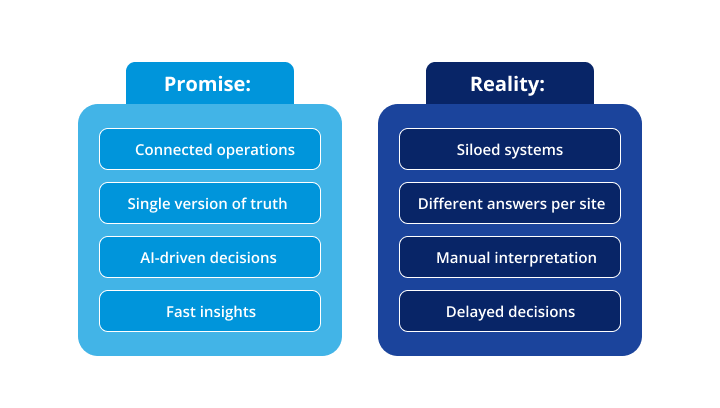
That is why starting with AI becomes a risky move. AI does not resolve inconsistency. It amplifies it. If the inputs are incomplete, time-misaligned, or missing context, the outputs may look polished while being harder to validate, and trust erodes quickly.
In manufacturing, this is not a minor operational issue. It is a scaling constraint. Local improvements are still possible, but reusable capabilities break down when the data cannot travel with consistent meaning across plants and into planning and supply chain decisions.
Why Industry 4.0 Projects Fail: Data Silos and IT/OT Integration Gaps
Most programs do not collapse. They stall. A site shows progress, a dashboard looks promising, and then replication slows down until it becomes a series of exceptions.
The reason is rarely model performance or platform selection. The constraint is structural. OT and IT systems were not designed to share ownership, change control, or security responsibilities, and data silos are reinforced by that divide. Without a repeatable pattern for publishing operational data with context, integration turns into a negotiation every time.
This is where IT/OT integration gaps become visible. You can build something locally without deep convergence, but you cannot scale reliably without shared definitions and consistent integration patterns that hold across sites.
Flow, Context, And Data Governance In Industry 4.0
When people hear data architecture, they often think about storage and platforms, including data lakes and warehouses, plus migration work. Those are important, but Industry 4.0 needs something more specific: an architecture that makes operational data usable at the moment decisions are made.
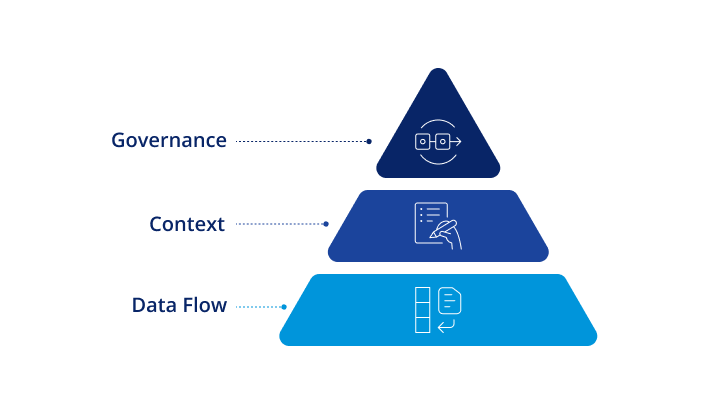
That starts with data flow. Operational signals need a reliable path from machines and plant systems into the places where they create value, without brittle point-to-point integrations that are hard to maintain and even harder to replicate across sites.
It also requires context. Raw values only become meaningful when they are paired with asset hierarchy, batch or order information, process-step metadata, quality events, and consistent time alignment. Without that layer, teams spend their time interpreting data instead of acting on it, and cross-site comparisons become guesswork.
Finally, it depends on data governance that is designed in from the start. Clear definitions, ownership, access rules, and change control keep the architecture stable as more plants, systems, and use cases are added. Without that discipline, the same concept gets implemented differently in different places, and the effort turns into rework.
This is also where digital precision becomes more than a slogan. Precision is what happens when the same operational question produces the same trustworthy answer across sites and functions, without manual interpretation.
Core Data Sources Behind IoT
Most manufacturing organizations already have many of the data sources Industry 4.0 relies on. The challenge is that these sources were not designed to support cross-site analytics, real-time streaming, and consistent decision loops.
Signals originate across plant-floor systems and data historians, while production execution context typically sits in MES and enterprise context in ERP. Maintenance, quality, and lab information often live in separate systems, and supply chain decisions rely on planning systems and logistics data.
These systems usually work well on their own, but they were not designed to work as one. As a result, the data is available yet disconnected, visible yet missing context, and difficult to compare across sites, which is what trapped data looks like in practice.
A scalable Industry 4.0 approach treats this as an architecture problem, not a reporting problem. You need a consistent way to publish and consume operational events across the ecosystem.
The Unified Namespace Imperative: Foundational Data Infrastructure For Scale
Unified Namespace (UNS) is one of the clearest patterns for breaking out of data silos. It is best understood as a shared, standardized representation of operational data, organized around a consistent model that different systems can publish to and subscribe from.
The key is that UNS is not a single database. It is a common data structure and access pattern that creates a single source of truth across systems, while allowing each system to keep doing what it does best.
When implemented well, UNS becomes foundational data infrastructure. It reduces integration complexity, improves interoperability across sites, and shortens the path from new signals to usable decisions. That is also why it pairs naturally with broader IoT data integration efforts.
The practical success factor is restraint. The fastest way to stall an UNS initiative is to overdesign it early. A more reliable approach is to standardize only what you need to make data reusable across sites, then expand deliberately as adoption grows.
Most organizations start by aligning a consistent asset hierarchy and naming conventions that can survive site differences, plus a minimum set of operational events that matter to the business. Over time, that foundation supports analytics, dashboards, digital twins, and automation that behave consistently across the network.
Event-Driven Architecture and Real-Time Data Streaming
UNS becomes significantly more powerful when paired with event-driven architecture and real-time data streaming.
Event-driven architecture is a simple idea with big operational consequences. Systems respond to events as they happen, rather than waiting for scheduled extracts or batch updates. This is how teams move from reporting on what happened to acting while it is happening.
This matters because many Industry 4.0 decisions are time-sensitive. Equipment behavior changes, quality signals drift, and supply chain constraints shift. If data arrives hours later, teams end up optimizing yesterday’s plant.
Real-time streaming also does not mean everything must be real-time. The goal is to stream where it changes outcomes and to use batch where latency does not affect decisions. When those choices are made intentionally, streaming improves operational visibility, supports faster response, and reduces uncertainty by making current conditions more reliable for downstream decision-making.
That is why organizations often connect event-driven patterns to real-time data processing initiatives that shorten the time from signal to action.
IT/OT Integration and the Operational Divide
IT/OT integration is often described as connecting systems. In reality, it is about building trust in shared data so teams can make decisions with the same definitions and the same context.
From an Industry 4.0 perspective, IT/OT integration allows operational signals to be combined with enterprise context, so decisions stay consistent across manufacturing and supply chain planning. It is also what makes cross-site scaling possible. Teams can build a local solution without deep integration, but replication becomes unreliable when each site requires a custom approach.
In most manufacturing environments, IT and OT convergence is a foundational requirement, not a step to postpone. Without common models and consistent integration patterns, ecosystems remain fragmented and every new connection turns into a one-off project.
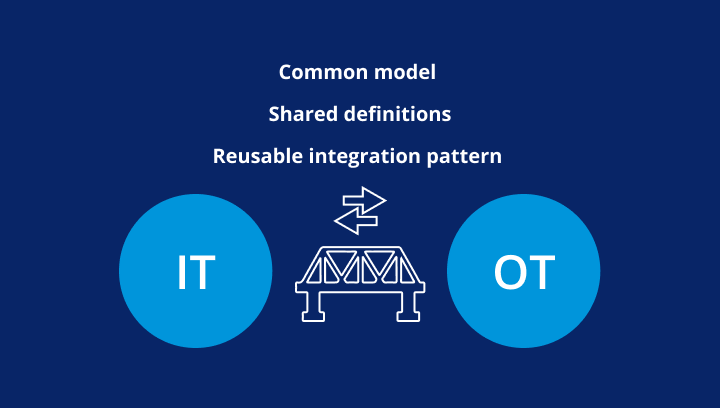
A practical approach is to treat connectivity as a reusable capability. Build the pattern once, then apply it across sites and systems. That is the difference between point integrations and scalable data connectivity that reliably brings site-level industrial data into enterprise platforms, supporting analytics at scale.
Edge Computing Versus Cloud: A Hybrid Processing Strategy
Industry 4.0 architectures often converge on a hybrid model because manufacturing needs two things at once. It needs low-latency response and resilience in the plant environment, where edge computing plays a critical role. It also needs centralized analytics, cross-site comparison, and model training, where cloud platforms add value.
The right balance depends on the use case and the operation’s risk tolerance. The key is that edge and cloud should not become two disconnected layers. They work best when they share the same data models and governance, so plant-floor signals can be interpreted consistently across sites and across teams.
When that alignment is in place, it becomes easier to support capabilities like predictive insights, near-real-time batch visibility, and digital twin initiatives that depend on consistent, contextualized data streams across assets and processes.
Data Storage Done Right
Industry 4.0 does not require a single storage technology. It requires an intentional storage strategy that matches how the business uses data.
Operational sensor signals often fit naturally in time-series databases because they capture high-frequency data with strong time indexing and efficient retrieval. Raw and semi-structured data often belongs in data lakes, where teams can preserve detail and revisit history without forcing structure too early. Enterprise analytics and standardized reporting typically rely on data warehouses, where curated models improve consistency, governance, and performance.
What matters most is not choosing a best platform but deciding which layer needs to be strong first based on the decisions you are trying to enable. When storage choices follow decision requirements, Industry 4.0 data architecture stays coherent and scaling becomes easier.
From Foundation To AI Readiness
The link between architecture and outcomes becomes especially clear in Industry 4.0 use cases that rely on prediction and optimization. These are architecture and data readiness initiatives first.
For predictive maintenance, success depends on consistent event capture, aligned time-series data, and reliable context about operating states, maintenance actions, and production schedules. For quality improvement, it depends on connecting process parameters with quality outcomes, which requires consistent definitions and traceable links between process signals, batch context, and quality results.
When shared foundations like UNS and event-driven patterns are missing, teams can still build models, but replication becomes the hard part. Each site tends to require bespoke integration and the same logic gets rebuilt in slightly different ways. With a common structure and governance in place, those capabilities become easier to scale because the data arrives with consistent context and meaning across plants.
Data Governance and Security in Cyber-Physical Systems
Industry 4.0 makes manufacturing more connected, which also increases exposure. Once IT and OT converge, organizations are operating a cyber-physical ecosystem where security and governance need to be designed into the architecture, not added after the fact.
When governance is treated as part of the foundation, it supports scale rather than slowing it down. Stable definitions, clear ownership, consistent access rules, and disciplined change control reduce rework as new sites join and new use cases are added, while keeping data trustworthy over time.
A useful reference point is the NIST supply chain traceability meta-framework draft, which highlights interoperability through a common data model as a way to integrate data across participants and ecosystems. While it focuses on traceability, the architectural principle translates directly to Industry 4.0: common models and governance are what turn fragmented signals into usable, reliable information flows.

Value-Based Digital Roadmap Creation
Explore the essential steps to crafting and executing a roadmap, so it delivers measurable value, secures stakeholder buy-in, and drives long-term success.
Incremental Transformation: Building Value Layer By Layer
A big-bang approach looks efficient on a slide. In practice, it is one of the fastest ways to exhaust a program, because every exception becomes a debate and every connection becomes a one-off.
Incremental does not mean slow. It means sequenced. Each step reduces uncertainty and makes the next step easier, rather than adding new complexity.
A practical starting point is a narrow slice of shared data infrastructure in a high-value area where data already exists but is hard to use consistently. Standardize the namespace for that slice, implement event flows that enable real-time visibility, then validate the pattern by applying it under different site conditions. From there, expansion becomes predictable because the model and governance are already established.
This approach also leaves room for operational reality. Some sites will be modern and flexible, while others will be legacy-heavy. Sequencing lets you build a scalable pattern while still making progress in the environments you actually have.
A useful industry perspective is that manufacturing transformation increasingly sits alongside resilience expectations, not only digitalization and sustainability, which raises the bar for coordinated change and consistency across ecosystems.
Business Value and Use Cases in Industry 4.0
The practical payoff of a solid data architecture is that decisions get faster and more consistent across sites. Teams spend less time reconciling numbers and more time acting, because operational data arrives with the context needed to interpret it the same way in every plant.
That stability is what makes higher-value capabilities sustainable at network level. Near-real-time batch visibility, earlier detection of process drift, faster deviation triage, and more reliable schedule response all depend on the same condition: data that can travel with consistent meaning from the plant floor into planning and quality workflows.
Start With Data Architecture, Not Trends
The simplest test of digital precision is consistency. That is why data architecture needs to come before AI readiness if you want outcomes that scale.
Can teams ask the same operational question in different sites and systems and get the same answer, with the same context, and the same level of trust.
UNS helps by providing a shared model that breaks down data silos. Event-driven patterns and real-time streaming shorten the time from plant event to action. IT/OT integration makes context portable across the operational and enterprise layers. Edge and cloud work best as a hybrid when they share models and governance, and storage layers matter most when they match the decisions they need to support.
When those building blocks are designed deliberately, digital precision becomes achievable. The organization moves from isolated improvements to scalable capabilities, from data locked in systems to data that drives decisions, and from trend chasing to durable Industry 4.0 progress.
FAQ
What Is Industry 4.0 Data Architecture?
Industry 4.0 data architecture is the structure that enables operational data to move reliably from OT and IoT sources into usable, contextualized information for analytics and decision-making. It focuses on flow, context, and governance so data can scale across systems and sites, rather than staying trapped in silos.
What Is a Unified Namespace (UNS) in Manufacturing?
A Unified Namespace is a shared, standardized representation of operational data that creates a consistent model across machines, OT systems, and enterprise applications. It helps break down data silos by making operational events and states available in a uniform structure that different systems can publish to and consume from.
Why Does Predictive Maintenance Depend On IT/OT Integration?
Predictive maintenance relies on combining OT signals with context from maintenance, production, and enterprise systems. Without IT/OT integration, the data needed to interpret equipment behavior remains fragmented, which limits model trust and makes it difficult to scale predictive maintenance across plants.
Would you like more information about this topic?
Complete the form below.