
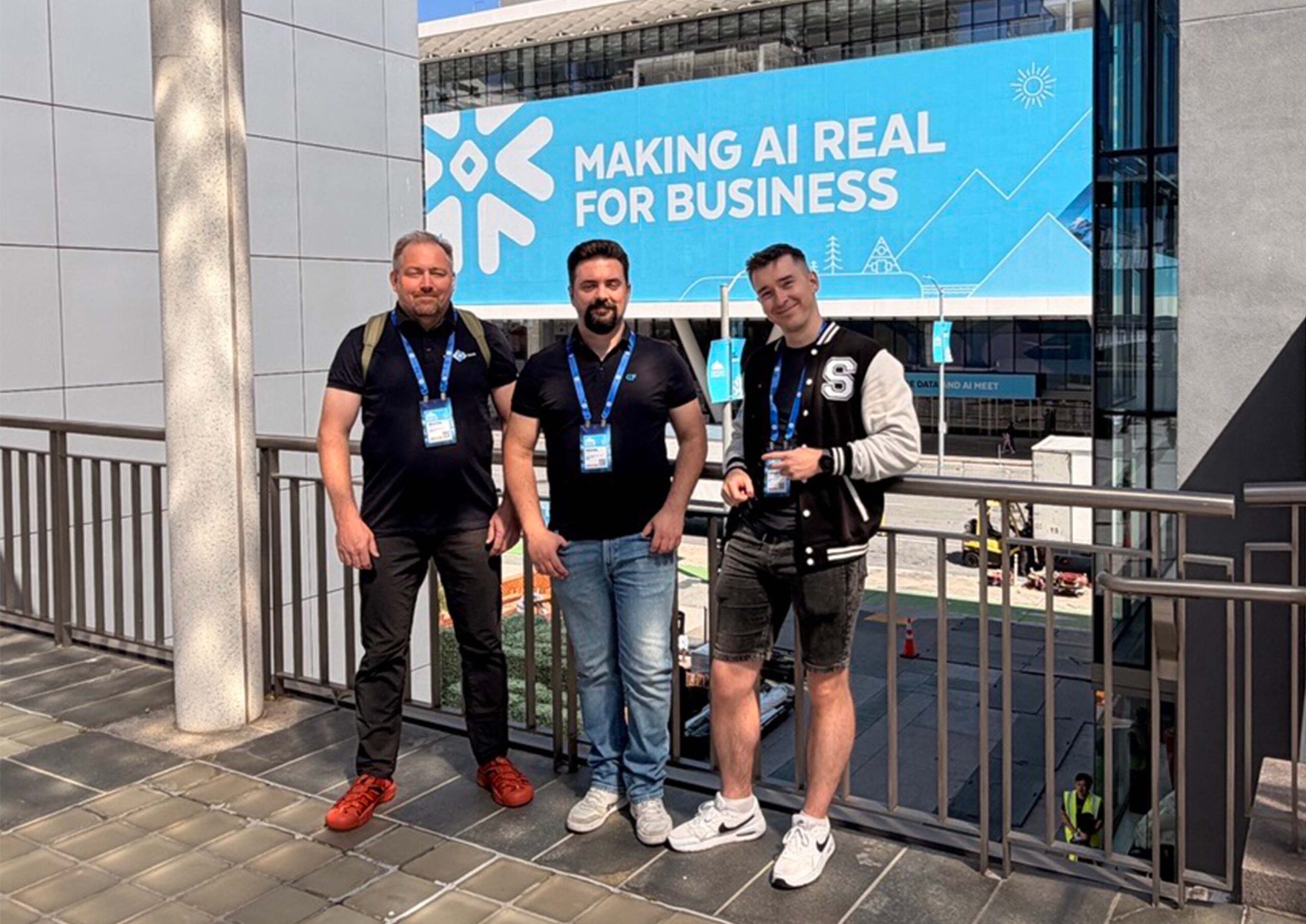
Our team spent four days at Snowflake Summit 2026 in early June. Wojciech Winnicki (CTO), Michał Werner (Head of Tech Practice, Data Engineering), and Sebastian Flak (Senior Data Engineer) made the trip to Moscone Center. The summit ran under the theme “Making AI Real for Business.” Past the headline announcements, what stayed with us was a clearer read on where Snowflake is placing its bet, and why that bet rests on work most enterprises have not finished.
CoWork, CoCo, and the Agentic Turn at Snowflake Summit 2026
The message running through every keynote was the agentic enterprise. Snowflake wants to move customers from querying data to acting on it, and it wants to be the governed platform where that action happens. The company called this the agentic control plane.
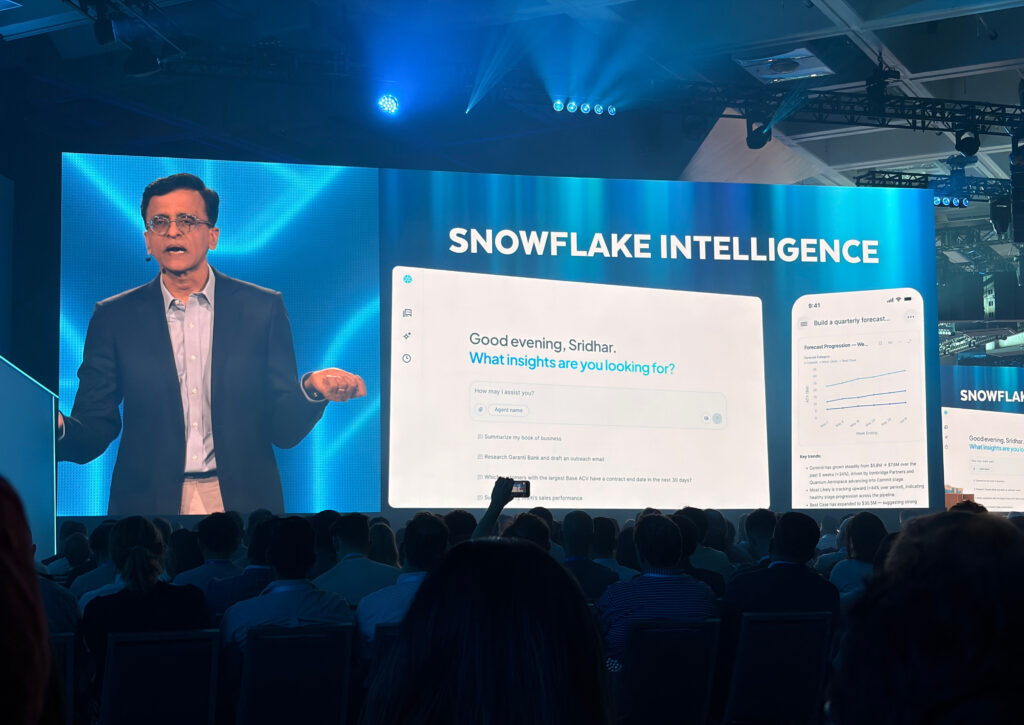
The most visible sign of the shift was a pair of renames. Snowflake Intelligence is now CoWork, a personal agent aimed at every knowledge worker. Cortex Code is now CoCo, the agent built for developers, data teams, and technical business users. CoWork lets people ask questions, analyze company data, build reports, automate tasks, and take secure actions across tools such as Salesforce, Google Drive, and Slack. CoCo builds pipelines, workflows, and AI applications from prompts, and it now reaches well beyond the browser: Snowsight, a standalone CoCo Desktop app, a CLI, and a VS Code extension A CoWork iOS app was also previewed, with Face ID and conversation history, and is expected to reach general availability soon.
Snowflake CEO Sridhar Ramaswamy framed it the same way from the keynote stage. Competitors can license the same models, which is why the advantage has to come from your own data. That is the part rivals cannot copy. Michał’s read from the floor was more measured. Snowflake’s coding agent is younger than the dedicated tools many engineers already use day to day, and parts of it still feel early. What stood out was the pace. Snowsight, a desktop app, a CLI, and a VS Code extension within months of launch, with support for current AI models and protocols added along the way. The distance to established coding agents narrowed quickly.
The Quiet Headline for AI: Context
If the agents were the headline, context was the substance. Two announcements carried that theme.
Horizon Context, a capability inside the Horizon Catalog, gives tools, teams, and agents the same governed business definitions to work from. It is built to bridge raw metadata and actual business meaning, so that an agent, a BI tool, and an application all read from one trusted version of the truth. Cortex Sense sits at runtime and assembles context the moment an agent needs it, pulling from query history, object metadata, and semantic views rather than waiting for a pre-built cache. Snowflake’s own benchmark showed answer quality on hard structured-data questions climbing sharply once full business context was supplied.
Sebastian’s read cut past the rebrands. “The bigger shift is not the new product names,” he said. Snowflake “wants to connect data, business meaning, AI, and company tools in one governed platform, because the real advantage will come from trusted business context, not from the AI model alone.” An agent can tell you a number went up. Only an agent that knows how your business defines that number can tell you whether the movement means anything. In a world where everyone can rent the same models, that distinction is where the competitive ground actually is.
Underneath the AI: Data Engineering Layer
For all the attention on agents, Snowflake kept investing in the plumbing underneath. Snowflake Datastream, an Apache Kafka-compatible streaming service, takes on much of the setup that real-time pipelines normally demand and lets Snowflake do the heavy lifting. Performance work landed across the platform, from low-latency interactive workloads to further gains on hybrid tables.
The Dynamic Tables deep dive was Michał’s personal highlight. “This was my top personal pick,” he said, “because of our long history with Dynamic Tables, having used them in client projects since the very beginning, when they were first released in GA.” The session covered refresh boundaries, custom incrementalization, and performance work that, in his words, “only proves that Snowflake hasn’t forgotten about its core data engineering toolkit, even in the agentic AI era.”
Governance ran beneath all of it. The acquisition that fit the agentic theme most directly was Natoma, which adds enterprise MCP governance: controlling what agents are allowed to read, write, and act on across SaaS applications, databases, and tools, while keeping audit trails and verified agent identity intact. Open data sharing across platforms was another recurring point, with interoperability positioned as a genuine selling argument rather than a checkbox.
The Work That Makes Agents Useful
One last-day breakout session on assessing and improving AI readiness matched conversations we have been having. Teams are told to “just enable AI.” Business colleagues are pushed to do more of their daily work through it. The result, more often than anyone admits, is quiet disorder, and the people asked to manage that change find it genuinely hard.
The session was a useful reminder that the work which makes agents useful is the unglamorous work. Data quality, governance, semantic definitions, clear ownership. None of it photographs well in a keynote, and all of it determines whether a deployed agent earns trust or gets quietly abandoned. That is the work we expect to do with clients: a phased approach that gets the foundation right before the agent sits on top of it.
The products will keep changing names and adding capabilities. The constraint underneath them will not. An agent is only as good as the governed context it can reach, and that context is something each organization has to build and maintain for itself. It is the part Snowflake cannot ship in a release, and it is where a lot of our work with clients sits.