

- 1. Why Animal Health Decisions Still Arrive Too Late
- 2. Where Reporting Reaches Its Ceiling in Animal Health
- 3. The Interpretation Tax: The Hidden Cost of Turning Data Into Decisions
- 4. How Decision Intelligence Works: The D.A.T.A. Loop
- 5. Why Now Is the Moment for Animal Health
- 6. How to Start With Decision Intelligence: Small Wins First
- 7. Questions We Hear From Animal Health Leaders
- 8. Decision Intelligence: The Rear-View Mirror Problem
Michał Osuch, Head of Animal Health Business Unit, C&F
A sales dip appears in one territory. The number is real, the dashboard is accurate, and the data was refreshed on time. Rep coverage for that week sits in another report. Stock levels sit in a third. What none of them will tell the brand lead is which one explains the dip, or whether a competitor has been working the same clinics since March. So he exports the view, sends it around, and books a meeting for Thursday. By the time the group agrees on what happened, the season the forecast depended on has turned, and the competitor has had three more weeks with those clinics.
Nothing in that sequence is a data problem. Every number the brand lead needed already existed. What was missing was the connection between them and an owner for the next step. The delay sits in what happens after the chart, in the space between someone noticing a deviation and the right person acting on it. Most analytics investment goes into everything upstream of that space. Decision Intelligence is built to close it.
Why Animal Health Decisions Still Arrive Too Late
Animal Health runs on signals that expire. A safety signal on a product, a shortfall on a seasonal line, a shift in what veterinary practices are ordering, a regional producer changing supplier. Each has a window in which a response still changes the outcome, and those windows are shorter than most reporting cycles.
Our industry also carries a structural quirk that shapes this. Animal Health sits several years behind Human Pharma in data maturity, and that is usually described as a disadvantage. I read it differently. Teams are smaller, reporting lines are shorter, and there is less accumulated platform debt, which means the distance between a decision-maker and the data is often shorter here than inside a large pharma organization. Access is rarely the constraint. The analytical system simply stops at the point where the decision begins.
Forrester puts a number on that distance. Companies with advanced insights capabilities are more than 8.5 times more likely than beginners to report annual revenue growth of 20% or more.
In Animal Health the lag rarely looks dramatic from the inside. It looks like a restocking call made a week late, or a field-force reallocation that lands after the quarter has already closed.
Where Reporting Reaches Its Ceiling in Animal Health
For years we built reports, dashboards, KPIs, self-service tools, and semantic layers. That work was necessary, and it still is. What formed around it in many organizations is a closed circle: report, analysis, export to Excel, meeting, interpretation, follow-up, decision, delayed action. The decision still happens outside the analytical system, in email threads and calendar invites that the system has no way of seeing.
The friction is recognizable once you look for it. Data is available while the context that would make it actionable is not. Users leave the dashboard to ask a question, validate an assumption, raise a task for a rep, or chase an approval somewhere else. Where AI has been added, it usually sits on top as a feature rather than inside the workflow where the decision gets made.
Decision Intelligence vs Business Intelligence: What Actually Changes
None of this means BI failed. BI remains the foundation, and it did exactly what it was built to do. What changed is the expectation around it. Business users no longer need only more reports. They need faster interpretation and an easier path from what they see to what they do about it, and reporting tools were never designed to carry them that far.
Business Intelligence made data visible. Decision Intelligence makes it usable at the moment the decision gets made, by connecting data, interpretation, recommendation, and action inside one system instead of scattering them across four. In practice, that is the difference between a dashboard telling a brand team that rep visits and sales both rose in a territory, and a system that establishes whether the visits actually drove the sales, then routes that finding to the person who owns the next call.
BI vs DI
| Business Intelligence | Decision Intelligence | |
| The question it answers | What happened? | What should we do about it? |
| What it does with context | Shows the number | Explains what sits behind it |
| Where it ends | At the chart | At the action |
| Where the decision is made | Outside the system, in email, meeting etc. | Inside the workflow, with an owner attached |
The Interpretation Tax: The Hidden Cost of Turning Data Into Decisions
Between the reporting investment and the bottom line sits a mechanism that has never had a clean name, which is part of why it has never been managed. Call it the Interpretation Tax: the time and effort an organization spends translating data into a decision.
It looks like manual analysis, slide preparation, and cross-referencing four sources to confirm a number that a fifth source already flagged. Then waiting two days for someone senior to decide what could have been decided a week earlier with a ready recommendation.
Naming it matters because budgets manage what they can see. Until the cost has a label, it accumulates inside ordinary line items: analyst headcount, software renewals, consulting engagements, hours spent in standing meetings. The aggregate eventually becomes visible to the executive who asks why the analytics function looks expensive and slow at the same time. By then it has been paid for several years.
Decision Latency: The KPI Most Analytics Programs Never Track
Most analytical deployments get measured by what is easy to measure: uptime, dashboard counts, active users. None of these answer whether the organization is making better decisions faster. A platform can be fully operational and heavily used while the time between a signal appearing and someone acting on it stays exactly where it was a year ago.
Decision Latency is that time. Classical BI never recorded it, because the decision happens outside the analytical system and never comes back as data. The metric does not exist in the tool, so the cost never enters the conversation and never gets managed. When Decision Intelligence enters an organization, this is usually the first number that becomes visible. It is rarely comfortable to look at.
How Decision Intelligence Works: The D.A.T.A. Loop
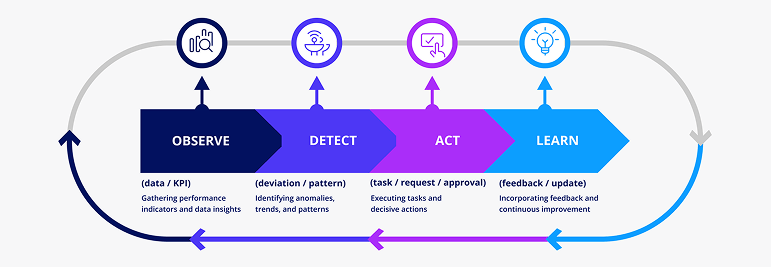
Most BI conversations end with a chart. The decision that chart was supposed to enable starts somewhere else, in places the analytical system cannot see. We describe the full cycle as D.A.T.A., the Data Analytics Transformation Approach, and it has four phases.
Observe is the gathering of indicators on a dashboard. Detect is the moment someone notices a deviation or a pattern. Act is a task, a request, or an approval issued in response. Learn is feedback returning to the system so that subsequent decisions get sharper.
Classical BI handles the first two phases, and only partially. The third and fourth happen outside the analytical system entirely. Decisions arrive late, on yesterday’s read of a situation that has already moved. The same problem gets re-analyzed across successive meetings because context evaporates between them, and the system that flagged the original signal has no way of knowing whether anyone ever acted on it. Most of the practical work of Decision Intelligence goes into closing that loop.
Why Decision Intelligence Extends Your Existing Reporting Ecosystem
What makes this approach viable in Animal Health is that it does not require replacing the reporting core the organization already runs on. Decision Intelligence is an evolution of, and an extension to, existing solutions. Current processes keep running while new capabilities are added on top, and only where they bring tangible business value. That has a direct effect on ROI, because no technology replacement is required and effort concentrates where the return is highest. The existing commercial data ecosystem stays as the foundation, with new elements built around it.
The trade-off is real. This is slower to announce than a full platform programme, and it produces less impressive slides in year one. Organizations that skip the incremental path and run Decision Intelligence as a transformation programme tend to stall on adoption long before the more interesting capabilities pay off.
Why Now Is the Moment for Animal Health
The Decision Intelligence market is growing at around 15% CAGR, and 75% of enterprises plan to adopt Decision Intelligence practices by 2026. The point of those numbers is timing rather than trend-following. Speed is now being set by AI, and the organizations that evolve their analytics ecosystem in the next two years will be operating with a structural advantage over those that wait.
For Animal Health, this is the moment to keep pace with other industries. The position is favourable for the same reason it was described earlier as a weakness. There is less legacy to unwind and there are fewer layers between a signal and the person who owns it, so several of the detours that larger sectors had to take can be skipped.
How to Start With Decision Intelligence: Small Wins First
Organizations that treat Decision Intelligence as a large programme rarely finish it. The ones that move pick a single decision problem, validate the result in weeks, and use that result to fund the next step.
The diagnostic context for that choice is a maturity model with four stages. Descriptive BI answers what happened. Augmented Analytics answers why it happened, with anomaly detection and conversational agents bolted onto existing reports. Decision Intelligence answers what to do next, with prescriptive models, semantic layers, and a closed loop between detection and action. Agentic Decisioning executes bounded decisions without waiting for human input.
The practical problem is that most organizations sit at stage two and believe they are at stage three. That gap is where budget disappears. Until the loop between detection and action actually closes, every additional dashboard added to a stage two platform extends the Interpretation Tax rather than the analytical estate.
The remaining gap between a working model and an actual decision is almost never technical. People need to trust the data and understand the logic behind a recommendation, and they need to feel that the call is still theirs to make. A recommendation the accountable person does not believe in changes nothing. Capability that people do not use is infrastructure cost.
Questions We Hear From Animal Health Leaders
We already have strong BI and a good data warehouse. Is Decision Intelligence something separate?
No. It builds on what you have. If the warehouse and the reporting layer are sound, most of the prerequisite work is done, and the remaining question is where decisions currently stall. Organizations with the strongest BI estates are often best positioned to move, because the data foundation does not need rebuilding.
Our teams are already stretched. What does a first pilot realistically require?
One decision and one team, with a scope narrow enough to produce a result the business can feel inside a quarter. The criterion for choosing it is operational rather than technical: which decision takes three weeks longer than it should, and what do those weeks cost. Weeks rather than months is the right expectation for a first module.
What if our field data quality is uneven across markets?
Then start where the data is strong and prove the loop works there. Uneven data quality should narrow the first scope rather than delay it. A decision loop deployed into a domain with weak data produces recommendations nobody trusts, and it discredits the approach before it has had a chance to demonstrate anything.
One question is worth taking into the next leadership meeting. How long does it take, in this organization, between a signal appearing (a territory sales dip, a competitor launch, a safety signal, a shortfall on a seasonal product) and the right person acting on it? Most Animal Health executives can answer that from experience, even when no system tracks it formally. If the honest answer is unclear or uncomfortable, that is where to start.
Decision Intelligence: The Rear-View Mirror Problem
We went deeper into that question in our whitepaper, Decision Intelligence: The Rear-View Mirror Problem, which sets out the maturity model, the implementation sequence we use in Animal Health engagements, and how to measure Decision Latency once you decide to track it. Download it here: Decision Intelligence: The Rear-View Mirror Problem. Why Animal Health analytics shows the road behind — and how to look ahead
Would you like more information about this topic?
Complete the form below.