



Home Services Internal Developer Platform

Internal Developer Platform

Build a developer experience your data teams will actually use. With our golden-path approach (a standardized, automated workflow for the most common developer requests) that balances self-service speed with built-in governance, you’ll get the operational layer you need to ship data products faster, build consistency across teams, and keep your existing controls intact.

What an Internal Developer Platform changes for your business

The value of an Internal Developer Platform comes down to governed velocity: your teams move faster, and your controls hold while they do. Speed on its own creates risk, and governance on its own creates queues. A platform delivers both from the same mechanism. Most modern data platforms provide what you would expect: compute, storage, orchestration, and analytics. What they rarely provide is a consistent way for teams to build and operate on top of them. The result is friction every engineer recognizes: weeks of repository setup, manual access requests, scattered approvals, and a platform team that turns into a ticket queue. An Internal Developer Platform closes this gap by encoding your organization's standards into reusable workflows, so teams move faster and your existing controls scale with them.

Faster time to first value

Engineers stop spending one to three weeks configuring repositories, pipelines, and access before writing transformation logic. With a golden path in place, sandbox and new project provisioning runs in minutes. Hands-on-keyboard work was always hours; the calendar time was waiting.

Self-service that keeps your existing controls

Sandbox and project requests move from Excel intake and email handoffs to a Backstage form with required fields enforced upfront. Approvers, security reviews, data governance checks, and FinOps oversight stay in place. The clarification ping-pong, queue time, and lost email threads disappear.

A single source of truth across teams

The catalog ends the "does this already exist?" question that lives in Teams and Confluence. Services, data products, APIs, pipelines, and ML models are modeled as queryable entities with ownership, lineage, and dependencies. Automated providers keep the catalog in sync with GitHub, Kubernetes, Airflow, and your cloud inventories.
Icon showing two people in front of a screen

Higher-leverage platform team

Platform teams own the rails the work runs on. Time goes to golden path development, standards, and treating the platform as a product. Their leverage grows as the platform matures.

Consistent onboarding for engineers and analysts

A new joiner's day-one environment is created from the same golden path everyone else uses, with tools, access, sample data, and ready-to-run examples. Time-to-productivity drops from weeks to hours, and new hires learn the shared way of working from the start.

Audit-ready by design

When projects are created through a platform workflow, key information is captured automatically: who created what, which template version was used, which metadata was provided, and which approvals were applied. Audit trails become a property of the system, captured automatically across every workflow.

Why this matters now 

AI has raised the stakes on platform quality. Around 90% of software professionals now use AI at work, up 14% year over year (DORA 2025). Individual output rises quickly, yet organizational delivery often stays flat, because friction in the surrounding platform absorbs the gains before they reach the business. DORA’s 2025 research names internal-platform quality among the capabilities that decide whether AI investment pays off at the organizational level. On a weak platform, that investment returns close to nothing. 

Platform engineering is also becoming standard practice. Gartner expects around 80% of large software organizations to run dedicated platform teams by the end of 2026, up from 45% in 2022. The organizations treating the platform as a product are the ones turning AI adoption into measurable delivery. 

The payoff is a business outcome rather than an IT metric. McKinsey’s Developer Velocity Index found that companies in the top quartile for developer velocity grew revenue four to five times faster than those in the bottom quartile, and identified best-in-class tools as the single largest contributor to velocity, ahead of culture and talent. An Internal Developer Platform is that lever, applied to the highest-friction part of a data estate: data and AI delivery. 

Our approach to building Internal Developer Platforms

We co-design platforms with the teams that will actually use them. Paths built by the platform team in isolation tend not to stick. Real adoption comes from solving a problem your engineers already feel, with the people who feel it in the room from week one. 

One golden path, then scale 

A golden path is a standardized, automated end-to-end workflow for a common developer task: form submission, provisioning, catalog registration, and governance applied at creation. Most IDP initiatives fail when they try to build too many of them at once. We start with the single most time-consuming workflow your teams repeat, often sandbox or new project provisioning, and codify it end to end. The first path is designed jointly by the platform team, two or three consuming teams, and every approver in the chain. Time-to-sandbox is measured before and after, so the value is visible. 

Once that path is adopted and trusted, we expand systematically: 

  • Ingest existing assets into the catalog through automated providers 
  • Add the next golden path in priority order based on team friction 
  • Layer in plugins for monitoring, cost visibility, and lineage where they add value 
  • Operate, refine, and harden over time 

Backstage as the foundation

We build on Backstage, the open-source framework Spotify built to run over 2,000 backend services and 4,000 data pipelines, then open-sourced in March 2020 and donated to the Cloud Native Computing Foundation. It has since become the de-facto standard, with roughly 89% share among organizations that have adopted an internal developer portal, and is used at scale by Netflix, American Airlines, HP, and Expedia, among many others. It provides the core building blocks of an IDP: 

  • Software catalog offers a queryable inventory of services, data products, APIs, resources, systems, and domains, with ownership and relationships modeled as a graph. 
  • Software templates (scaffolder) define multi-step workflows that create repositories, provision infrastructure, set up CI pipelines, and register entities from a single form. 
  • TechDocs brings documentation-as-code alongside source, rendered inside the platform and attached to the entities it describes. 
  • Plugin system extends the platform with over 100 open-source plugins for GitHub, Kubernetes, Grafana, Airflow, PagerDuty, and other tools in your stack. 

Backstage gives us a battle-tested foundation. We extend it with the patterns your teams actually need, including data-specific entity types, ML project scaffolding, and integrations with the tools you already run. 

Buy versus build, weighed honestly

A self-hosted Backstage platform gives you full control over customization, data product modeling, and integrations, with no vendor lock-in. The trade-off is operational burden, since upgrades, patching, and hosting are yours. SaaS alternatives such as Port and OpsLevel reduce the operational lift and shorten time to first value, while customization is bounded by vendor extensibility and catalogs typically live in vendor-controlled storage. 

For most data organizations we work with, the answer depends on three things: how unique your data product taxonomy is, how much customization you need around governance, and whether catalog data can leave your perimeter. We help you make that decision with eyes open, before any code is written. 

From current-state read to a running platform in three phases 

We work in three phases, and you decide whether to continue at each one with evidence in hand. 

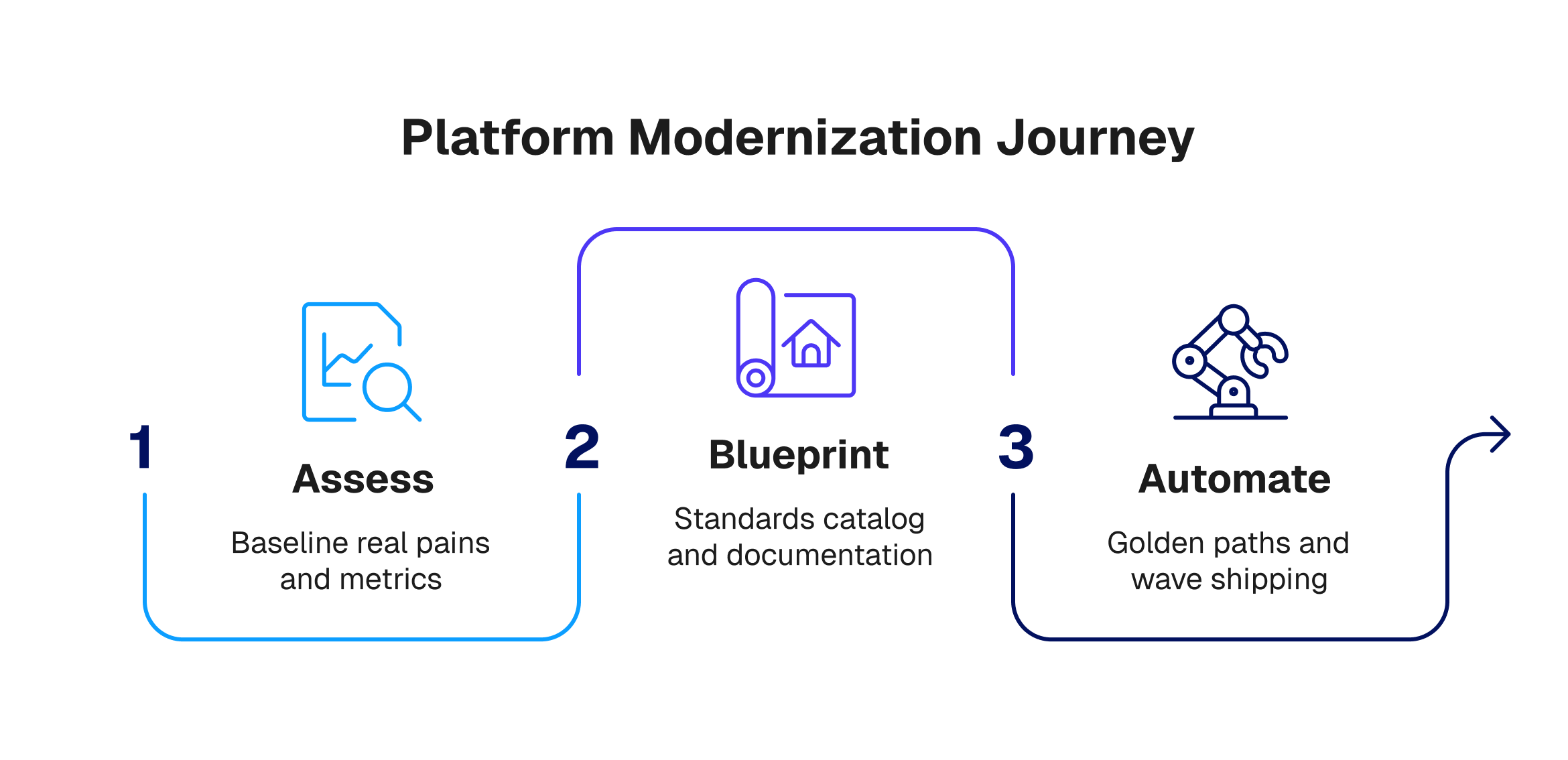
In Assess, we read your current state against industry standards and hand you a baseline of your real pains, metrics, and platform maturity. In Blueprint, we turn those findings into a standards catalog, a documentation site, and a starter automation library your teams can use straight away. In Automate, we build the platform itself: golden paths co-designed with your teams, shipped in waves, with a run model your platform team owns. 

Each phase stands on its own. An assessment is useful even if you stop there, and every phase de-risks the one that follows. 

How we deliver

Co-design with consuming teams

The platform team, two or three engineering or data teams, and every approver in the chain participate in design from week one.

Self-service workflows

A self-service workflow replaces a process that already takes weeks. Controls are applied at form submission, so by the time the environment is running, every check has already happened.

Governance encoded in templates

Data classification, naming, quality gates, and access policies live in the templates themselves; compliance becomes the default state.

Measurable outcomes at every phase

Time-to-sandbox, time-to-first-commit, and number of paths in production are measured throughout. Decisions about further investment are grounded in evidence.

Start with a 4-6-week pilot 

We offer a fixed-scope pilot as the practical way to start. The scope is deliberately narrow: one golden path (typically sandbox or new project provisioning), Backstage stood up and integrated with your existing infrastructure, the catalog seeded with the products in scope, and your existing approvals wired in unchanged. 

Week one baselines your real request volumes and your loaded engineering cost, so the starting picture rests on your numbers rather than an estimate. From there we co-design and build the first golden path end to end, with the platform team, two or three consuming teams, and every approver in the chain in the room. 

By the end of the engagement, the platform is running, one golden path is in production, and the calendar-time win is proven on real work. You have evidence on whether the approach fits your environment before committing to broader rollout. 

The pilot is the right start when you already know a platform is the answer. When that question is still open, begin with an assessment instead. We score your current state across technical, data, delivery, operations, security, and cost, and you leave with a baseline report and a ranked list of what to fix first. That read tells you whether a platform is worth building before you commit budget to one. 

A platform that goes beyond developers

In a data organization, self-service unlocks more than engineers. Once the foundation is in place, the same mechanism delivers value to analysts who need governed notebook environments, product managers prototyping a dashboard or model, and partners or auditors needing time-bounded access that expires automatically. AI experimentation benefits in particular: pre-wired LLM and GPU sandboxes with governed data access lower the prototyping bar to the people closest to the business problem. 

An experienced partner for enterprise data platforms

C&F brings over 25 years of experience delivering complex, business-critical data solutions for global enterprises in highly regulated industries, including Fortune 500 organizations in life sciences, animal health, and CPG. We have built data platforms, governance programs, and ML systems for organizations where compliance, audit readiness, and operational reliability are non-negotiable from day one. We work as a partner: we co-create with your teams, build internal capability, and leave you with a platform your engineers want to use. 

"A platform is a product, and your engineers are the customers. The day the golden path is slower than going around it, they go around it. Our whole job is making the default path the fastest one."

FAQ

How is an Internal Developer Platform different from a developer portal or a wiki?

A wiki or portal documents what exists; an IDP operates it. The catalog stays in sync with reality through automated providers, templates handle provisioning, and approvals run in-product with audit trails. The difference shows up the first time a new project goes from form submission to a running environment in minutes, with no ticket opened.

We already have project templates and a reference repository. Do we still need an IDP?

Templates and reference repositories are a starting point, but they tend to drift. Without ownership and automation, they accumulate outdated patterns, hardcoded configurations, and assumptions that no longer apply. Every new project inherits that debt from day one. An IDP turns static templates into governed, versioned golden paths with provisioning, approvals, and catalog registration built in. Your existing reference repo can be the seed for the first golden path.

When does investing in an Internal Developer Platform make sense?

The clearest signal is multiple teams independently solving the same setup problems. If your platform team spends most of its time provisioning environments, granting access, and answering "how do we start a new project" questions, the gap is structural. Smaller organizations with one or two data teams can usually manage with well-maintained templates and clear documentation. The value of an IDP grows quickly with scale.

How long does it take to deploy?

The platform itself can be stood up and integrated with SSO, source control, and your basic infrastructure within two weeks. The first golden path that delivers measurable time savings typically takes four to six additional weeks, co-designed with one consuming team and every approver in the chain. Coverage of around 80% of common workloads is usually a three to six month horizon. Operating and refining the platform is continuous, and a typical run team is one to two engineers.

Will a standardized platform reduce team flexibility?

A well-designed IDP makes the common case easy and consistent while still allowing teams to deviate when there is a real reason. The default path covers about 80% of cases without requiring deep platform expertise. The remaining 20% remains available through normal infrastructure access. The goal is to remove the friction tax on the common path. The long tail stays open for teams that genuinely need it.

What does an Internal Developer Platform change for AI and ML projects?

Significantly more than for traditional analytics. ML projects involve training infrastructure, experiment tracking, feature engineering, model registries, deployment, and drift monitoring. Without standardization, every team builds its own version of this stack. Standardized blueprints provision the full ML environment from a single request, with governance applied at creation. This shift is often what separates organizations that experiment with AI from those that reliably deliver AI-powered products at scale.

Let's talk about a solution

Our engineers, top specialists, and consultants will help you discover solutions tailored to your business. From simple support to complex digital transformation operations – we help you do more.