

- 1. Why Point-to-Point Architectures Become Expensive
- 2. The Challenge Multiplies Across Manufacturing Networks
- 3. How a Unified Namespace Changes the Economics
- 4. Illustrating the Difference
- 5. The Business Case Strengthens Across Multiple Sites
- 6. The Benefits Extend Beyond Data Consumption
- 7. Looking Beyond the Initial Investment
Gaining visibility over manufacturing processes is not as easy, and requires connecting several systems. A dashboard requires data from the historian. A reporting tool needs information from the MES. Energy monitoring is added. A cloud analytics initiative follows. Each project is delivered independently, solving an immediate problem and creating tangible business value. And for now, I’m only talking about a single production plant, not a whole manufacturing network.
Individually, every point-to-point integrations makes perfect sense. Collectively, they often create an architecture that becomes increasingly expensive to maintain and difficult to scale. The first integration is easy. The real challenge comes after the tenth, the fifteenth, or the thirtieth.
Why Point-to-Point Architectures Become Expensive
Every new digital initiative depends on data from one or more operational systems. A production dashboard may require information from a historian, an MES, and PLCs. An analytics project could combine production data with quality records and ERP information. Before long, each new use case introduces several additional integration points.
Consider a single production site running six digital initiatives, each consuming data from two or three different systems. That quickly translates into approximately fifteen individual integrations, each requiring its own development, testing, maintenance, and support.
But the number of connections is only part of the story. What I want to focus on is the work that has to be repeated every time another integration is introduced.
Data Contextualization Is Repeated Again and Again
Raw manufacturing data is rarely ready for immediate use. Equipment tags need to be mapped to consistent naming conventions, engineering units standardized, metadata added, and information aligned with models such as ISA-95 before different systems can interpret it consistently.
In a point-to-point architecture, this contextualization effort is typically performed independently for every single integration. Even if multiple projects rely on the same underlying data, much of the transformation work is recreated from scratch. As the number of integrations grows, so does the amount of duplicated engineering effort.
Every New Use Case Starts from Zero
Point-to-point environments also make it harder to launch new digital initiatives. A data science team developing a predictive maintenance model, for example, may first need to request historian access, understand existing tag structures, normalize inconsistent data, and build a dedicated integration pipeline before any analytics work can begin.
A lot of effort needs to be put into the preparation phase, and not the part that actually delivers tangible value. Instead of accelerating innovation, the integration layer becomes one of its biggest bottlenecks.
Operational Systems Become Increasingly Burdened
Each additional point-to-point connection also places more demand on source systems. Historians, MES platforms, and other operational applications were not designed to serve a constantly growing number of downstream consumers. As more dashboards, reports, AI models, and cloud services query the same systems independently, performance can degrade and operational risk increases.
The impact extends beyond slower reporting. In some environments, excessive load on critical systems can affect manufacturing operations themselves.
The Challenge Multiplies Across Manufacturing Networks
As I mentioned, the integration complexity can be a problem even for a single production plant. But what about an entire network operating multiple manufacturing facilities?
Each site often has its own historian, MES instance, equipment landscape, naming conventions, and locally developed integrations. What appears to be one integration strategy at the enterprise level is, in reality, several independent architectures that have evolved separately. Sites that were added the network as a result of mergers and acquisitions are an obvious culprit, but even without them you might have a lot of these issues.
As a result, successfully deploying a solution at one facility does not automatically make it deployable elsewhere. Rolling out the same dashboard, analytics model, or AI use case frequently requires rebuilding integrations and repeating contextualization work for every additional site.

Internal Developer Platforms: The Missing Dashboard in Your Data Platform
In this episode of C&F Talks, Konrad Madej and Maciej Kłodaś discuss internal developer platforms and what they change for data teams. They cover how to spot the friction that justifies building…

From Vision to Value: A Practical Take on Industry 4.0
A practical conversation on Industry 4.0 that cuts through hype and shows why digital transformation succeeds through strong data foundations, realistic maturity goals, and human-centric change.

Is the Animal Health Industry Ready for AI?
In this episode of C&F Talks, Michał Osuch and Maciej Kłodaś discuss whether the animal health industry is ready for AI. They explore practical use cases, common adoption challenges, and the steps…

Commercial Excellence in Pharma: From Data Silos to Autonomous Growth
Commercial Maturity Model for pharma: move from data silos to autonomous growth. Heath Durrans on assessing capabilities and building realistic roadmaps. Listen to the episode now!

IoT Solutions and Product Tracking in the Life Sciences Industry
Discover how IoT technologies are transforming operational visibility in the life sciences industry. Explore practical insights from our successful pharma projects.

Building a Long-Term Partnership With a Fortune 500 Client
Discover how to earn a chance to deliver a business-critical project for a Fortune 500 company and how to stay agile in a highly regulated industry.

Next Best Action in Pharma Sales
Learn how pharma companies use AI-driven insights and predictive analytics to deliver Next Best Action at scale. A practical look at driving engagement and results.
How a Unified Namespace Changes the Economics
A Unified Namespace (UNS) takes a fundamentally different approach. Instead of treating integration as a growing collection of separate connections, it creates a shared, structured layer where operational data is published once and made available to every authorized consumer. In practice, the UNS becomes a common industrial data backbone: production events, equipment states, quality information, energy consumption, and other operational signals are organized in a consistent hierarchy that reflects how the business and its manufacturing assets actually operate.
This means applications no longer need to connect directly to every historian, MES, PLC, or enterprise system. Source systems publish data into the namespace, while dashboards, analytics tools, AI models, cloud platforms, and operational applications subscribe to the information they need. The architectural change may seem straightforward, but its economic impact is significant: the organization moves from rebuilding integrations project by project to reusing a governed foundation that can support many initiatives over time.
Contextualization Happens Once
Within a platform approach, each source system is onboarded and contextualized a single time. Tag mappings, metadata, engineering units, and equipment models become reusable assets rather than project-specific deliverables.
Instead of contextualizing fifteen separate integrations, an organization contextualizes five source systems once and reuses that work across every future initiative. The effort required to onboard each data source remains similar, but the cumulative cost decreases dramatically as new use cases are added.
New Use Cases Become Configuration Rather Than Engineering
Once trusted, contextualized data is available through the Unified Namespace, enabling another dashboard, analytics model, or reporting application becomes largely a matter of configuration.
Rather than designing and building another bespoke integration, teams simply subscribe to data that already exists within the platform. This significantly reduces both implementation time and engineering effort, allowing new initiatives to move from idea to delivery much faster.
Illustrating the Difference
To demonstrate how these approaches compare, consider a representative scenario based on manufacturing integration projects delivered for global industrial organizations. I based the numbers on client projects I had opportunity to work on, but of course they’re just estimates. Actual costs will vary depending on technology, scope, and site complexity, but the relationship between the two approaches remains broadly consistent.
Imagine a single manufacturing site supporting six digital use cases, each requiring data from an average of two to three operational systems.
With a point-to-point approach, the environment requires approximately fifteen individual integrations. Assuming an average integration cost of $65,000, plus $15,000 for contextualization per connection, the total investment reaches roughly $1.2 million.
Under a Unified Namespace approach, the economics change considerably. A typical implementation includes:
- Platform implementation: $250,000
- Five source systems onboarded at $65,000 each
- Contextualization performed once per source at $15,000
- Six use cases enabled for approximately $5,000 each
The total investment is approximately $680,000, representing a saving of around 43% for a single site.
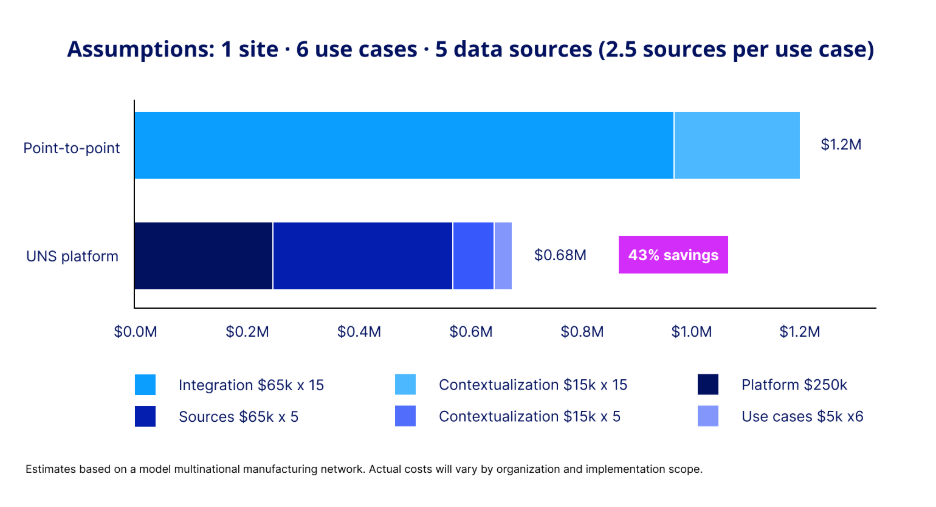
More importantly, the financial break-even often occurs after only the third or fourth use case. Beyond that point, each additional initiative costs only a fraction of what a new point-to-point integration would require. The more use cases, the more value for money you get from the UNS implementation.
The Business Case Strengthens Across Multiple Sites
The difference becomes much larger when organizations scale beyond a single facility. Within a Unified Namespace platform, much of the implementation work performed at the first site becomes reusable. Source onboarding can be standardized using templates, reducing onboarding costs for subsequent sites to roughly $15,000 per source, while existing applications can often be deployed with minimal additional engineering.
Point-to-point architectures do not benefit from the same economies of scale. Each facility requires its own integrations, contextualization effort, and implementation work.
Using the same cost model, the comparison becomes increasingly compelling:
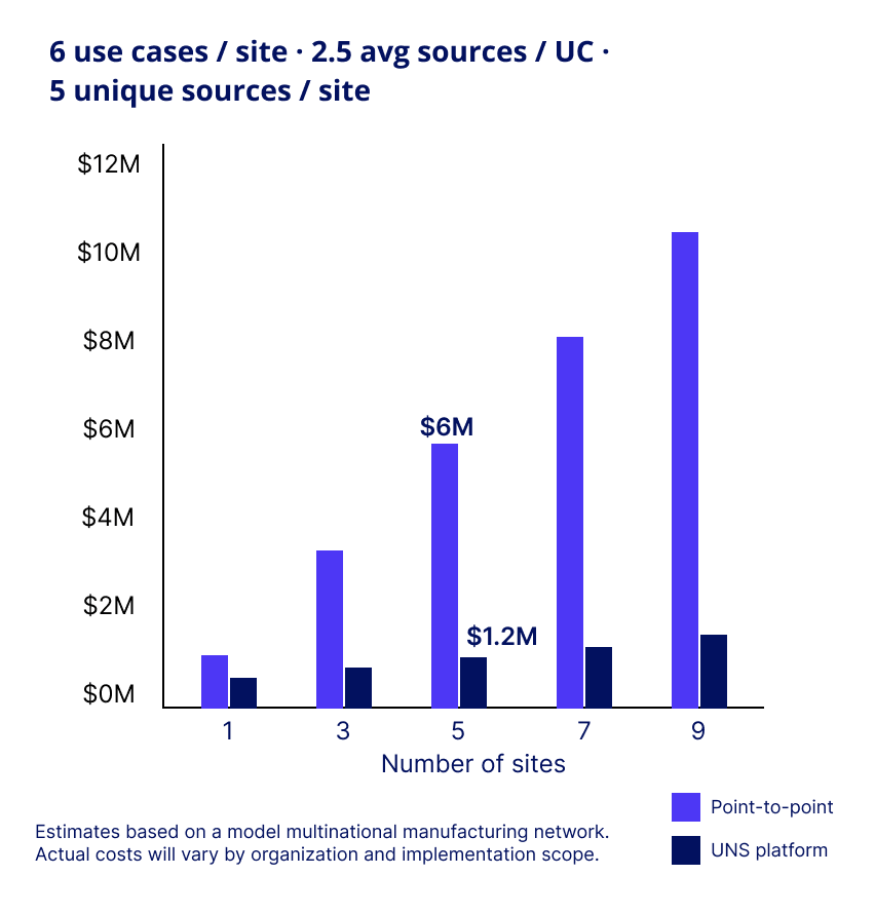
While point-to-point costs grow almost linearly as new facilities are added, platform costs increase much slower because the underlying foundation has already been established.
The Benefits Extend Beyond Data Consumption
The calculations above focus on one important category of use cases: data consumption. Dashboards, analytics platforms, AI applications, reporting solutions, and cloud services all benefit from easier access to trusted, contextualized information. These use cases also make the financial comparison relatively straightforward.
However, the same platform can support operational integrations as well. Order dispatch between ERP and MES, recipe management, machine setpoint updates, production acknowledgements, and other bidirectional communication scenarios can all leverage the same publish-subscribe infrastructure.
As a result, the investment made to improve data connectivity and simplify consumption also creates a scalable foundation for real-time operational integration, delivering additional value that is not reflected in the cost comparison above.
Looking Beyond the Initial Investment
Organizations evaluating a Unified Namespace often begin by asking whether the platform itself is worth the investment. A more useful question is how many digital initiatives the business expects to deliver over the next three to five years, and how many manufacturing sites those initiatives will ultimately support.
For organizations planning only one or two isolated projects, point-to-point integrations may remain a practical choice. But for manufacturers building multiple dashboards, analytics solutions, AI applications, and operational integrations across a growing production network (so most if not all enterprises), the economics shift quickly. Once the same foundation is reused repeatedly, the marginal cost of each new initiative falls dramatically.
The strongest business case is often built through a proof of value at a single site. By measuring the effort required to deliver the second and third use case on the same platform, organizations can replace assumptions with real implementation data and make future investment decisions with greater confidence.
Would you like more information about this topic?
Complete the form below.