

- 1. The Digital Maturity Paradox in Manufacturing
- 2. Why Chasing Maximum Maturity Everywhere Leads to Failure
- 3. What Digital Maturity Really Means and Why Level 5 Is Not Always the Goal
- 4. The Digital Plant Maturity Model as a Strategic Framework
- 5. Why Industry-Specific Maturity Models Matter
- 6. Core Principles of the DPMM Framework
- 7. Digital Maturity Levels: From Paper-Based to Data-Driven Manufacturing
- 8. Maturity Assessment: Uncovering Every Rock Across Your Manufacturing Network
- 9. DPMM and Industry 4.0: Making Smart Manufacturing Actionable
- 10. Data Architecture as the Foundation for Digital Maturity Progression
- 11. Quick Wins Strategy: Digital Action Logs and High-Impact Improvements
- 12. Solution-First vs. KPI-First: Different Approaches for Different Organizations
- 13. From Digital Maturity Assessment to Transformation Roadmap
- 14. Business Outcomes: Why Targeted Maturity Beats Blanket Transformation
- 15. Challenges and Best Practices in Using Maturity Models
- 16. DPMM As Your North Star, Not Your Destination
- 17. FAQ
When transformation programs lose momentum, it is often because the organization cannot make clean choices. Too many initiatives remain plausible, and priorities become difficult to defend, sequence, and execute across multiple plants.
A well-run digital maturity assessment helps by establishing a shared baseline. It makes differences visible across sites, clarifies what is actually constraining progress, and gives leaders a stronger basis for prioritization than anecdotes or the loudest local pain point.
That is where the BioPhorum Digital Plant Maturity Model (DPMM) comes in. It provides a structured way to assess current state and translate it into a practical direction of travel. The point is not to chase maximum maturity everywhere. The point is to invest where capability improvements translate into business value across the network.
The Digital Maturity Paradox in Manufacturing
IMost manufacturing organizations can point to digital projects that are already underway. Yet many still struggle to run plants and supply chains with consistent confidence, especially when they need to compare performance across sites, replicate improvements, or respond to disruption without improvisation.
This paradox is why maturity frameworks have regained attention. They replace debate with reference points. Instead of arguing whether a plant is advanced or behind, teams can agree on which capabilities are present, which are missing, and which ones should be raised first.
Why Chasing Maximum Maturity Everywhere Leads to Failure
Treating maturity like a ladder that every domain must climb to the top usually creates more friction than progress.
One issue is capacity. Even when budgets exist, change capacity does not scale as quickly as executive ambition. Too many initiatives collide in the same space, competing for operational time, data access, and governance attention.
Another issue is coherence. When each site pursues maturity in its own way, transformation becomes a patchwork. Local wins still happen, but network learning slows down because improvements are not comparable and methods diverge.
The final issue is measurement. If the roadmap tries to do everything, it becomes harder to show why each investment matters. Funding decisions drift toward internal bargaining, and leaders lose the clear line between capability work and outcomes.
What Digital Maturity Really Means and Why Level 5 Is Not Always the Goal
Digital maturity in manufacturing is best understood as the ability to make decisions quickly and consistently, supported by reliable data, stable processes, and clear ownership. Technology is part of that picture, but only one part.
A plant can be mature in one domain and immature in another. A company can also be mature in a single site and inconsistent across the network. That is why the most useful maturity target is rarely a blanket Level 5 goal. Many organizations benefit more from selective maturity thresholds, where capabilities reach the level needed to support the outcomes that matter most.
Targets should reflect context. A capability that underpins multiple value streams may justify a higher maturity level. A capability that supports stability and compliance may only need to reach a strong, repeatable baseline.
The Digital Plant Maturity Model as a Strategic Framework
DPMM is an industry-developed model created through BioPhorum to support structured assessment and transformation planning in manufacturing. It is designed to help organizations benchmark current state, set target maturity levels, and use results to build a roadmap. BioPhorum also provides a DPMM assessment tool aligned with the model, which many organizations use as a starting point for structured evaluation.
For leaders, the practical advantage of DPMM is that it creates a shared language that can work across operations, IT, quality, and supply chain. It also shifts the conversation from projects to capabilities, which makes prioritization easier to defend.
Why Industry-Specific Maturity Models Matter
Generic maturity frameworks can be helpful, but they often miss what makes manufacturing hard at scale: regulated processes, complex quality interfaces, and operational realities that vary by site while still needing to be comparable across the network. An industry-specific maturity framework gives you a manufacturing maturity model that reflects how plants actually run, rather than how enterprise transformation looks on paper.
That matters because a capability assessment is only useful if it leads to decisions leaders can defend. When capability areas and digital maturity levels are defined in a way that fits manufacturing operations, the results translate more directly into a digital transformation roadmap, including what to standardize first, what can remain local, and what dependencies will block progress toward Industry 4.0 maturity if they are ignored.
Core Principles of the DPMM Framework
Maturity frameworks only help when they are organized in a way that reflects how manufacturing actually operates. DPMM does this by breaking maturity into domains and capability areas that can be assessed consistently.
At a high level, the framework supports three decisions leaders repeatedly need to make:
- How to define current state in a way that is comparable across plants.
- How to set target maturity by domain, rather than assuming one maturity level fits everything.
- How to connect maturity findings to roadmap sequencing and investment choices.
This structure is also what makes maturity assessment useful at network scale. Without consistent capability definitions, teams may still collect information, but the outputs remain hard to compare and difficult to turn into a coherent plan.
Digital Maturity Levels: From Paper-Based to Data-Driven Manufacturing
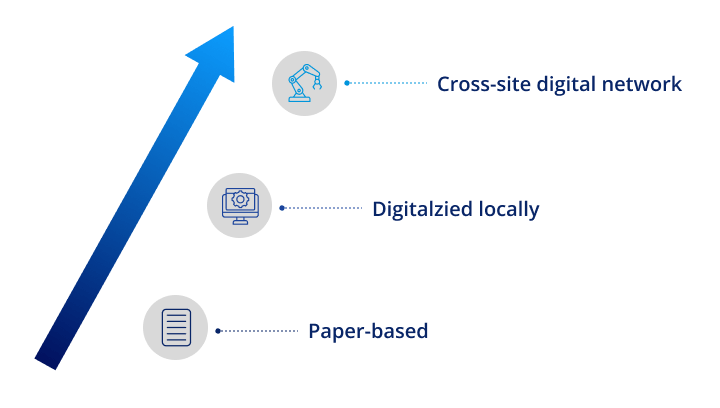
DPMM maturity levels help leaders describe progression without turning it into a race. The details vary by domain, but the logic is broadly intuitive.
At the lower levels, work relies heavily on paper, manual coordination, and local knowledge. Data may exist, but it is often difficult to access in a timely way or to compare across systems. As maturity increases, data becomes more structured, more trusted, and more usable for decision-making. Processes become more standardized, and ownership becomes clearer. At the higher levels, capabilities support proactive and automated decision loops, with governance that can sustain change across sites.
A helpful way to use maturity levels is to treat them as a planning tool. Ask what needs to be true for a domain to operate at the next level, then decide whether that improvement is worth funding now given the outcomes you want and the constraints you face.
This is also where the Level 5 misconception shows up. There is rarely a business case for moving every domain to the highest maturity level. In many organizations, Level 2 or Level 3 maturity in several domains can unlock meaningful gains, especially when those gains are consistent across the network.
Maturity Assessment: Uncovering Every Rock Across Your Manufacturing Network
A maturity assessment can surface gaps leaders already suspect exist. The value is that it makes them visible and consistent across sites.
When such evaluations are done site by site with a standardized structure, patterns start to emerge. Some gaps are local and can be addressed locally. Others repeat across plants and point to systemic constraints, such as inconsistent definitions, unclear ownership, or data that cannot be reused.
This is what teams often mean when they say assessments uncover every rock. It is not about collecting more information for its own sake. It is about exposing the constraints that keep initiatives from scaling, and doing it in a way that supports prioritization rather than debate.
Benchmarking is a practical byproduct. Once sites are assessed using the same model, leaders can compare maturity by capability area and focus investment where it will reduce network friction.
DPMM and Industry 4.0: Making Smart Manufacturing Actionable
Industry 4.0 often arrives as a bundle of concepts, technologies, and promises, especially when the goal is Industry 4.0 maturity across a network rather than isolated improvements. Maturity frameworks translate that bundle into capability work that can be planned, funded, and measured.
This translation matters because smart manufacturing maturity is rarely blocked by ambition. It is blocked by misalignment, inconsistent execution, and lack of comparability across sites. DPMM helps by turning a broad vision into a set of assessable capability areas, then tying those areas to a roadmap.
It also fits the direction manufacturing is heading. A useful industry perspective is that manufacturing transformation increasingly sits alongside resilience expectations, not only digitalization and sustainability, which raises the bar for coordinated change and consistency across ecosystems, as reflected in the World Manufacturing Report.
Data Architecture as the Foundation for Digital Maturity Progression
Nearly every maturity program eventually runs into a common constraint. Data exists, but it cannot be used consistently across systems and sites.
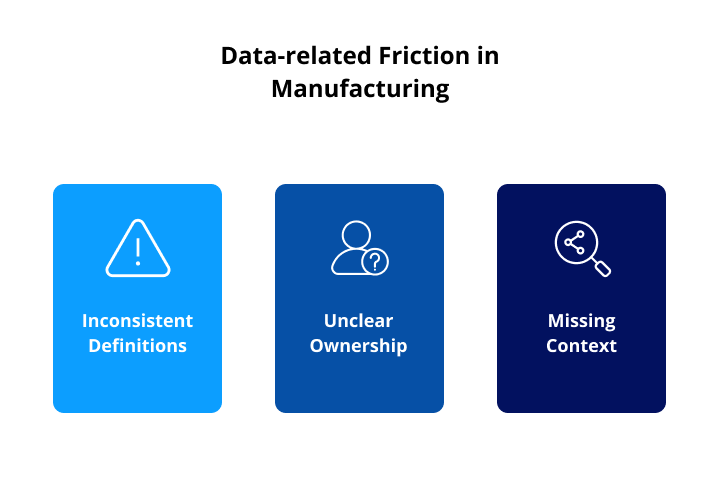
Maturity assessments often highlight the same categories of data-related friction:
- Definitions differ by plant, system, or team, which makes comparisons unreliable.
- Ownership and access are unclear, which slows down improvement work and increases risk.
- Operational context is missing, which makes analytics hard to trust and hard to operationalize.
These issues are not only technical. They affect adoption, governance, and how quickly improvements can be reused. That is why many roadmaps prioritize data work earlier than teams initially expect. Not because data work is fashionable, but because maturity cannot progress without it.
Maturity assessments often point to the same reality: progress depends on a small number of foundational capabilities that make data usable across systems and sites. That work typically includes data integration that standardizes definitions and improves comparability, data governance that clarifies ownership and controls change, and self-service analytics that makes insights accessible without creating a new bottleneck. When those capabilities improve together, maturity gains become repeatable instead of local.
Quick Wins Strategy: Digital Action Logs and High-Impact Improvements
Quick wins can accelerate maturity programs when they reinforce the direction of travel instead of creating new fragmentation.
Digital action logs are a good example because they improve operational clarity without requiring large platform change. Done well, they make issues visible, assign ownership, and reduce the time it takes to move from observation to action. They also support a discipline that maturity programs need: consistent capture of constraints and consistent follow-through.
The key is selection. Quick wins should be chosen because they remove friction in a way that will matter across more than one site, or because they support a capability theme identified in the assessment. When quick wins are disconnected from the roadmap, they tend to add noise and dilute focus.
Solution-First vs. KPI-First: Different Approaches for Different Organizations
Organizations often begin transformation from one of two instincts. Large corporations often default to a solution-first approach because standardization pressure is high, while smaller organizations tend to benefit from a KPI-first approach that protects focus and avoids building capabilities they cannot yet sustain.
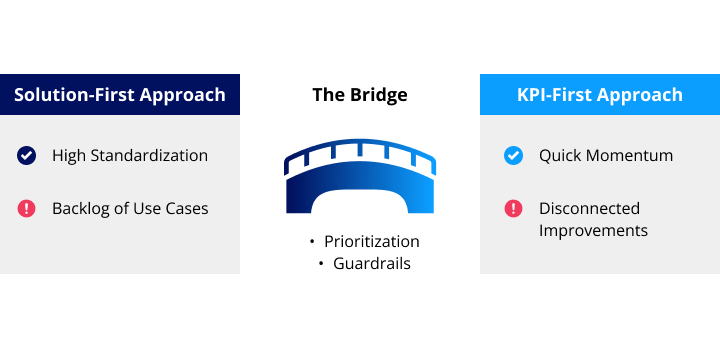
Solution-first programs often start with a platform or technology decision, then work backward to define where value will appear. This approach can succeed when governance and sequencing are strong, but it can also create a backlog of use cases that never become part of daily operations.
KPI-first programs often start with a measurable outcome and build only what is needed to move it. This can generate momentum quickly, but it can also produce disconnected improvements if the organization does not establish common standards early.
A maturity framework helps both approaches. It forces prioritization in solution-first programs and provides guardrails for KPI-first programs. In both cases, it makes it easier to connect workstreams to outcomes and to avoid treating activity as progress.
From Digital Maturity Assessment to Transformation Roadmap
The roadmap is where maturity work earns its keep. A useful digital transformation roadmap is more than a list of projects. It is an investment sequence tied to capability priorities, dependencies, and owners.
A strong investment sequence derived from DPMM results typically does four things.
It narrows focus to a small set of capability themes that matter across the network. Target maturity levels are set by domain and aligned to business outcomes rather than prestige. Sequencing logic is made explicit, including dependencies that must be resolved early. Ownership and decision rights are assigned so execution does not drift.
A digital maturity assessment becomes valuable when it drives clear next steps. The roadmap should translate findings into a small set of capability priorities, show the dependencies between them, and define how progress will be executed and governed across the organization. Many teams then move from assessment insights into focused workstreams such as data integration, metadata management, and decision enablement, so the improvements actually stick and scale across sites.

Value-Based Digital Roadmap Creation
Explore the essential steps to crafting and executing a roadmap, so it delivers measurable value, secures stakeholder buy-in, and drives long-term success.
Business Outcomes: Why Targeted Maturity Beats Blanket Transformation
Targeted maturity protects focus. It aligns investment with outcomes and reduces the spread of initiatives that compete for the same operational and governance bandwidth.
Organizations typically see the strongest returns when maturity improvements make decision-making more consistent across sites. That consistency reduces rework, improves comparability, and supports faster adoption of proven improvements. It also lowers risk because governance and ownership become clearer as capabilities mature.
Challenges and Best Practices in Using Maturity Models
Maturity models do not help when they become a compliance exercise. Scoring becomes the endpoint, and action becomes optional.
The more effective pattern treats assessment as a recurring management tool. Assess, prioritize, sequence, assign ownership, and revisit. Reassessment cadence keeps the roadmap honest as business priorities change and as sites progress at different speeds.
It also helps to protect the model from politics. A maturity assessment should not be used to rank sites as winners and losers. It should be used to expose constraints and support investment choices that improve the network as a whole.
DPMM As Your North Star, Not Your Destination
DPMM gives manufacturing organizations a clear method to assess current state, benchmark consistently across sites, set target maturity levels by domain, and build a roadmap that can be funded and executed.
The goal is not maximum maturity everywhere. The goal is a portfolio of capability improvements that translate into business value, reduce friction across the network, and support durable progress over time.
FAQ
What Is the Digital Plant Maturity Model (DPMM)?
The BioPhorum Digital Plant Maturity Model (DPMM) is a manufacturing maturity framework designed to help organizations assess digital maturity across capability areas, benchmark consistently across plants, and translate results into a transformation roadmap.
How Does a Digital Maturity Assessment Support a Digital Transformation Roadmap?
A digital maturity assessment creates a baseline that makes capability gaps comparable across sites. Those findings can then be prioritized, sequenced, and assigned owners to produce a roadmap that ties investment to outcomes and dependencies.
Do Companies Need To Reach Level 5 Digital Maturity Everywhere?
No. Many organizations benefit more from targeted maturity, where selected domains reach the maturity level needed to support consistent decisions and scalable execution. Pushing every domain to the highest maturity level often dilutes focus and increases change fatigue.
Would you like more information about this topic?
Complete the form below.