

- 1. What Agentic AI in CPG Truly Changes
- 2. Why Artificial Intelligence in CPG Has Reached an Inflection Point
- 3. AI Demand Forecasting: From Weekly Cycles to Real-Time Signals
- 4. AI Supply Chain Optimization and the Intelligent Supply Chain
- 5. AI-Driven Pricing Strategies and Smarter Promotions
- 6. Consumer Intelligence and AI in Retail Analytics
- 7. Decision Intelligence Across the Commercial Enterprise
- 8. Integration with Cloud, Big Data, and IoT in CPG Operations
- 9. Business Benefits of Agentic AI in Consumer Goods Companies
- 10. Challenges and Risks of Autonomous AI Systems in CPG
- 11. The Future of Agentic AI in the Consumer Packaged Goods Industry
- 12. FAQ: AI Agents, Assistants, and Automation
Consumer packaged goods companies operate at a scale that makes even small inefficiencies expensive. A demand forecast that is off by a few percentage points ripples into excess inventory, markdown pressure, and strained retailer relationships. A supply disruption that goes undetected for 48 hours can pull a product off shelves at the worst possible moment. The margin for error is narrow, the data is vast, and the decisions are constant.
That is precisely the environment where agentic AI in CPG offers something genuinely different. Not a better dashboard, not a faster report, but systems that monitor, reason, and act without waiting to be asked.
What Agentic AI in CPG Truly Changes
Artificial intelligence has been part of CPG operations for years, primarily in forecasting models, trade promotion analytics, and pricing optimization tools. These systems are valuable but passive. They produce outputs when queried and require human judgment to act on them.
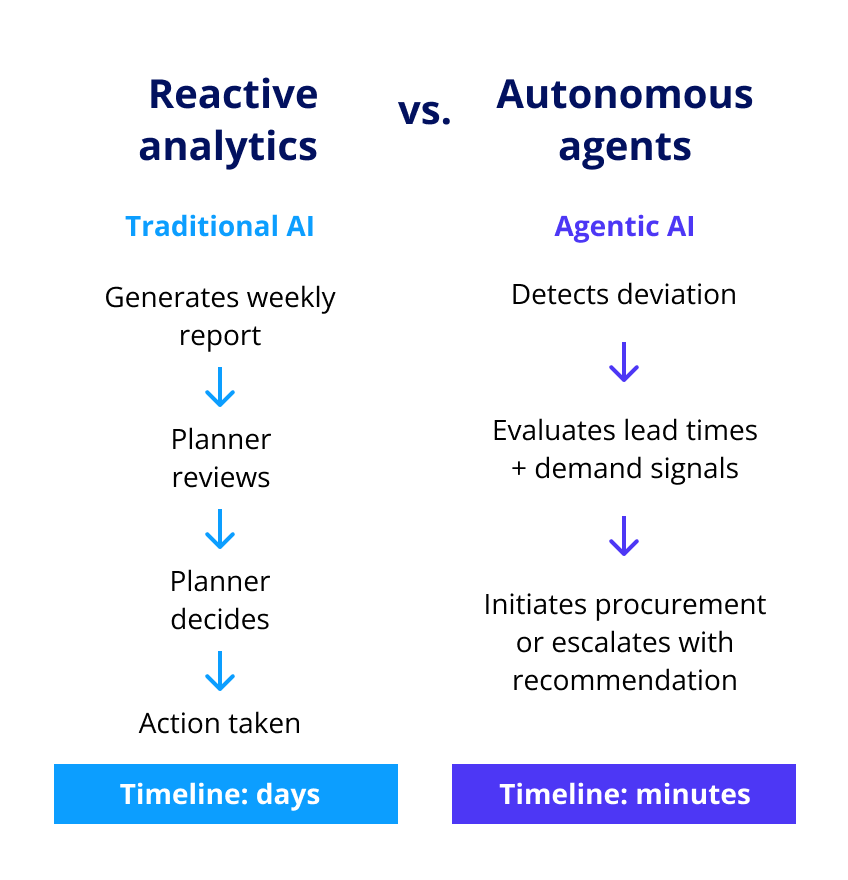
Agentic AI refers to autonomous AI agents that operate continuously based on environmental triggers rather than user prompts. An agent monitoring inventory across a distribution network does not generate a weekly replenishment report. It detects a stock deviation, evaluates supplier lead times and current demand signals, and initiates a procurement action (or escalates to a planner with a specific recommendation) without a human initiating the process.
That shift from reactive to autonomous changes not just speed but the nature of what gets managed. Problems that previously required human attention to surface can now be caught and resolved at machine speed, at a scale no team could match manually.
Why Artificial Intelligence in CPG Has Reached an Inflection Point
The adoption of artificial intelligence in CPG has accelerated sharply. A McKinsey survey of CPG leaders found that 71 percent had adopted AI in at least one business function, up from 42 percent in 2023. Yet the same research noted that no CPG company has truly scaled its AI capabilities across the value chain, leaving most of the potential value still uncaptured.
The competitive stakes of moving faster are real. McKinsey data shows that CPG and retail companies leading in digital and AI already deliver three times greater total shareholder returns compared to their sector peers. The gap between leaders and laggards is not narrowing but compounding as early movers build data advantages and organizational capabilities that are hard to replicate quickly.
Agentic AI is the next layer of that advantage. It converts data capabilities already built into autonomous operational decisions.
AI Demand Forecasting: From Weekly Cycles to Real-Time Signals
Demand planning in CPG has historically operated on weekly or monthly cycles, calibrated against historical sales with manual adjustments for promotions, seasonality, and market events. That cadence was adequate when markets moved predictably. It is increasingly inadequate when consumer behavior, competitor activity, and supply conditions shift faster than planning cycles can track.
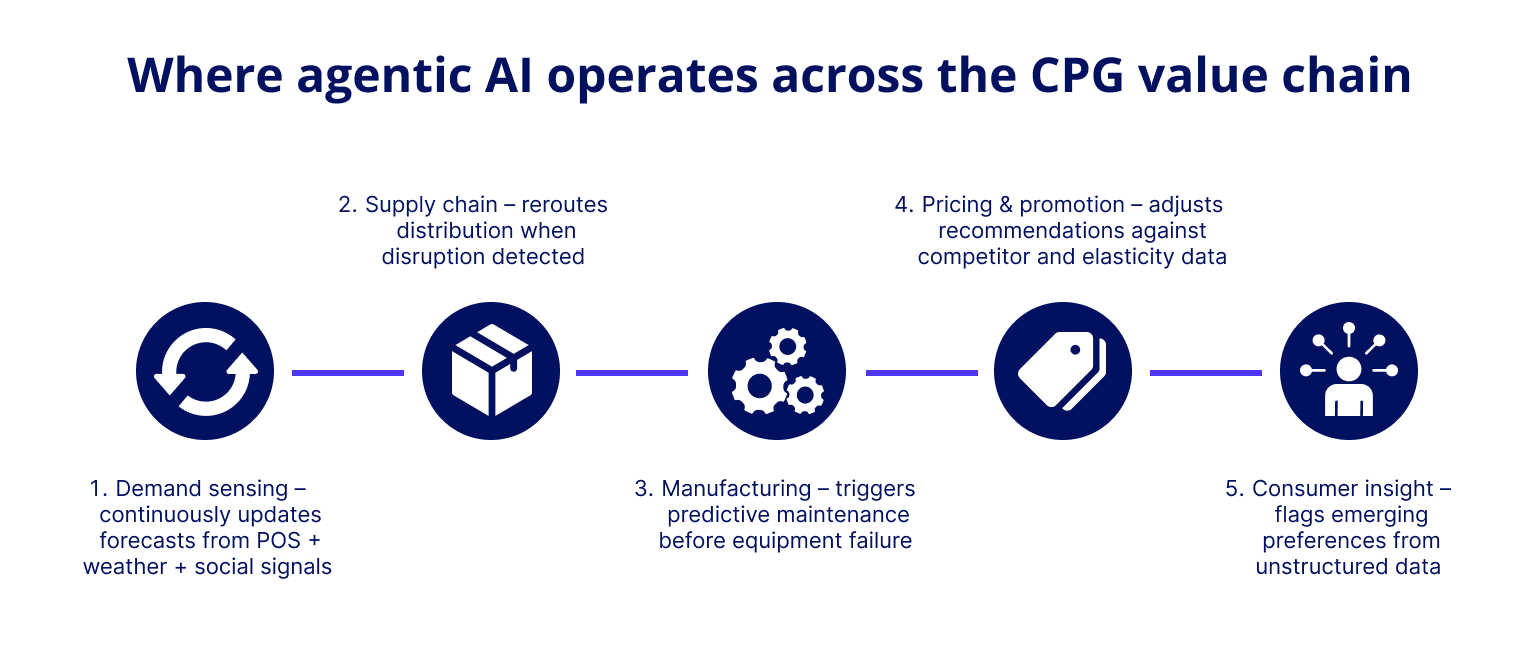
AI demand forecasting changes the temporal logic entirely. Agents ingest real-time signals, such as point-of-sale data, weather patterns, social media trends, promotional calendars, and regional economic indicators, and update forecasts continuously rather than periodically. McKinsey research finds that AI-driven forecasting reduces supply chain errors by 20 to 50 percent, translating into up to a 65 percent reduction in lost sales from stockouts, 5 to 10 percent lower warehousing costs, and 25 to 40 percent improvement in administration costs.
Predictive analytics in CPG also enables inventory optimization across multi-tier distribution networks, balancing service levels against carrying costs with a granularity that manual planning cannot approach. The result is less cash tied up in safety stock and fewer emergency replenishment actions eating into margin.
Table: The measurable impact of AI demand forecasting
| Metric | Impact of AI-driven forecasting |
|---|---|
| Supply chain forecast error | 20–50% reduction |
| Lost sales from stockouts | Up to 65% reduction |
| Warehousing costs | 5–10% lower |
| Administrative costs | 25–40% improvement |
AI Supply Chain Optimization and the Intelligent Supply Chain
The supply chain is where agentic AI’s autonomous capabilities are most immediately compelling. An intelligent supply chain is not one that provides better visibility but one where agents act on that visibility without requiring human intermediaries for routine decisions. Gartner predicts that by 2030, half of all cross-functional supply chain management solutions will use autonomous AI agents to execute decisions independently.
For CPG companies, AI supply chain optimization means agents that monitor supplier performance and logistics networks continuously, trigger procurement adjustments when lead times shift, reroute distribution when disruptions emerge, and flag at-risk commitments to retailers before they become service failures. Smart manufacturing sits within this layer. Agents supporting production scheduling, predictive maintenance of equipment, and process optimization in high-volume plant environments reduce unplanned downtime and smooth the handoff between manufacturing output and distribution planning.
AI-Driven Pricing Strategies and Smarter Promotions
Pricing and promotional investment represent some of the largest discretionary spending decisions CPG companies make, and some of the hardest to optimize. Trade promotion budgets run to billions across the industry, yet research consistently shows that much of this spend generates poor returns.
AI-driven pricing strategies use agents to monitor competitive pricing, retailer sell-through rates, and demand elasticity in real time, adjusting recommendations dynamically rather than on quarterly planning cycles. Promotional effectiveness improves when agents can model lift against cannibalization, evaluate timing against competitor activity, and sequence campaign execution across channels based on current inventory positions rather than plans made months in advance.
For CPG companies managing thousands of SKUs across dozens of retail partners, this kind of continuous commercial optimization is not achievable through human-led processes alone. Agents make it operational.
Consumer Intelligence and AI in Retail Analytics
Understanding what consumers want, and detecting shifts in preference before they show up in sales data, is a persistent competitive challenge in CPG. By the time a trend appears clearly in point-of-sale data, competitors have often already responded.
Agents analyzing consumer behavior across social media signals, search trends, review data, and purchasing patterns can identify emerging preferences earlier than traditional research methods. AI in retail analytics extends this to the shelf, analyzing velocity data by store, region, and channel to surface product performance patterns that inform both commercial decisions and innovation pipeline priorities. The same signals that flag a declining category feed directly into new product development briefs, shortening the cycle from consumer insight to market-ready concept.
One beverage company cited in McKinsey research used AI-driven consumer insight to inform product development, reducing time to introduce a new product to market by 60 percent.
Decision Intelligence Across the Commercial Enterprise
Individual applications of agentic AI in forecasting, supply chain, pricing, and consumer insights generate value independently. The greater opportunity is in their integration. Decision intelligence refers to the use of connected autonomous AI agents that synthesize signals from sales, operations, and marketing simultaneously to support faster and better-informed strategic decisions.
A CPG leadership team managing a product launch, a promotional push, and a supply disruption at the same time needs a unified picture of where the constraints are and what the tradeoffs look like. Decision intelligence platforms built on agentic architecture provide that picture in real time rather than through reports assembled after the fact.
McKinsey projects that by 2030, roughly 30 to 35 percent of all current activities across consumer functions could be automated, with CPG companies seeing the greatest impact given the concentration of automation opportunity in manufacturing and supply chain operations.
Integration with Cloud, Big Data, and IoT in CPG Operations
Agentic AI depends on the infrastructure beneath it. In CPG, that infrastructure spans cloud computing platforms that scale to handle enterprise-wide data workloads, big data pipelines that consolidate sales, supply chain, consumer, and market signals into a unified layer agents can reason from, and IoT sensors embedded in manufacturing equipment and cold-chain logistics that feed real-time physical data into operational agents.
The state of this infrastructure often determines how quickly agentic AI delivers value. Companies that have invested in cloud-based data platforms and standardized data flows across functions can deploy and scale agents significantly faster than those starting from a fragmented baseline.
Business Benefits of Agentic AI in Consumer Goods Companies
The business case maps to four outcomes: improved operational efficiency, reduced inventory costs, faster product launches, and better customer engagement. The demand forecasting and supply chain figures already cited (20 to 50 percent forecast error reduction, up to 65 percent fewer lost sales) translate directly into the first two. The 60 percent reduction in time to market from the product development example illustrates the third. Better customer engagement follows from getting the upstream decisions right: fewer stockouts, more relevant promotions, faster response to shifting preferences.
McKinsey estimates the combined potential of AI transformation in CPG at an additional $160 billion to $270 billion annually in EBITDA globally.
Challenges and Risks of Autonomous AI Systems in CPG
The gap between the potential and the current reality of agentic AI in CPG is largely explained by four implementation challenges the brief correctly identifies.
Data fragmentation is the most fundamental. Agents are only as good as the data they can access, and CPG data environments are typically fragmented across enterprise resource planning systems, warehouse management systems, retail partner portals, and marketing platforms that do not naturally communicate. Without a unified, clean data foundation, autonomous agents making procurement or pricing decisions will be working from incomplete signals.
Legacy system integration compounds this. Most CPG companies have core operational systems that predate modern cloud and data architectures. Connecting agents to those systems without disrupting live operations requires careful integration work that takes time and carries technical risk.
Governance of autonomous decisions is the challenge that receives the least attention and carries the most organizational risk. When an agent adjusts a pricing recommendation or triggers a purchase order, accountability needs to be clear. What decisions can agents make independently? Which require human confirmation? How are errors detected and corrected? These questions need answers before deployment, not after.
Cybersecurity risk increases as more systems become interconnected and autonomous actions are taken at machine speed. An agent with procurement authority that is compromised or manipulated represents a different threat profile than a reporting tool. Security architecture for agentic systems needs to be designed accordingly.
Table: Four readiness questions to answer before deploying agentic AI
| Field | Question |
|---|---|
| Data fragmentation | Can agents reach a unified, clean data layer across ERP, WMS, retailer portals, and marketing platforms? |
| Legacy system integration | Which core systems can be connected without disrupting live operations? |
| Governance of autonomous decisions | What can agents decide independently, and what requires human confirmation? |
| Cybersecurity | How is security architecture adapted for agents with procurement or pricing authority? |
The Future of Agentic AI in the Consumer Packaged Goods Industry
The trajectory of agentic AI in CPG points toward operations that look substantially different from today’s within five years. Autonomous supply chains, where agents handle the full cycle of demand sensing, procurement, production scheduling, and distribution without routine human intervention, are the near-term destination for companies that invest deliberately in data infrastructure and governance now.
Beyond operations, hyper-personalized consumer experiences where agents continuously adjust product recommendations, promotional offers, and channel engagement based on real-time individual behavior represent a medium-term opportunity that AI in retail analytics is already beginning to enable.
The companies that will capture these opportunities are not necessarily those that deploy the most agents fastest. They are the ones that build the data foundations, governance frameworks, and organizational capabilities to make autonomous AI systems reliable and accountable at scale. Agentic AI in CPG is an operating model transformation, and the preparation required is as much organizational as technical.
FAQ: AI Agents, Assistants, and Automation
1. What is the difference between traditional AI tools and agentic AI in CPG operations?
Traditional AI tools in CPG, such as demand forecasting models, trade promotion analytics platforms, pricing optimization software, produce outputs when queried and require human decisions to act on them. Agentic AI refers to autonomous AI agents that operate continuously based on environmental triggers. Rather than generating a replenishment recommendation for a planner to review, an agent monitors inventory levels, evaluates current demand signals and supplier lead times, and initiates action directly. The difference is not just speed but scale. Agents can manage thousands of concurrent decisions that no human team could handle simultaneously.
2. Where should a CPG company start with agentic AI?
Demand forecasting and supply chain monitoring are the most common and accessible starting points, combining high business value, relatively structured data, and well-established use cases. Predictive maintenance in manufacturing is another strong entry point, particularly for companies with IoT sensor data already in place. Pricing and promotion optimization tends to require more mature data integration before autonomous agents can operate reliably. The practical starting point is a specific, bounded operational problem with clean data and a clear metric for success, built as a contained pilot before scaling.
3. What are the biggest risks of deploying autonomous AI agents in CPG?
The most significant risks are governance-related rather than technical. Autonomous agents making pricing, procurement, or promotional decisions need clear accountability structures, i.e., defined boundaries for what they can do independently, human oversight mechanisms for higher-stakes decisions, and error detection and correction processes. Data quality risk is also high: agents operating on fragmented or inconsistent data will produce unreliable outputs, which can erode trust across the organization quickly. Cybersecurity risk increases as more systems become interconnected and autonomous. Companies that address governance and data quality before deployment consistently achieve better outcomes than those that add controls after problems emerge.
Would you like more information about this topic?
Complete the form below.