

- 1. What Agentic AI in Pharma Actually Means
- 2. How Artificial Intelligence in Pharma Got Here
- 3. AI Drug Discovery and the Race to Shorten R&D Timelines
- 4. AI-Driven Clinical Trials: Faster, Leaner, More Precise
- 5. AI in Pharmaceutical Manufacturing: Predictive Control on the Plant Floor
- 6. Decision Intelligence as a Strategic Layer
- 7. Integration with Cloud, Big Data, and IoT Technologies
- 8. AI Compliance and Regulation: Governing Autonomous AI in Pharma
- 9. The Future of Agentic AI in the Pharmaceutical Industry
- 10. FAQ
The pharmaceutical industry has always run on long timelines and high stakes. Bringing a single drug to market takes an average of ten years and 2.6 billion dollars, and the failure rate remains punishing. Most compounds that enter clinical development never reach patients. Against that backdrop, the arrival of agentic AI in pharma is a structural challenge to how the industry has always worked.
Artificial intelligence has been part of pharma for years. What is changing now is the nature of what that AI can do on its own. Autonomous AI agents monitor conditions, reason about what those conditions mean, and take action or recommend action based on predefined goals without waiting for instructions. That matters enormously in an industry where every bottleneck in the R&D pipeline carries a real cost, and where every decision touching patient safety requires accountability.
What Agentic AI in Pharma Actually Means
The phrase “agentic AI” gets used loosely, often interchangeably with chatbots or AI assistants. In pharma, the difference is significant enough to be worth stating clearly.
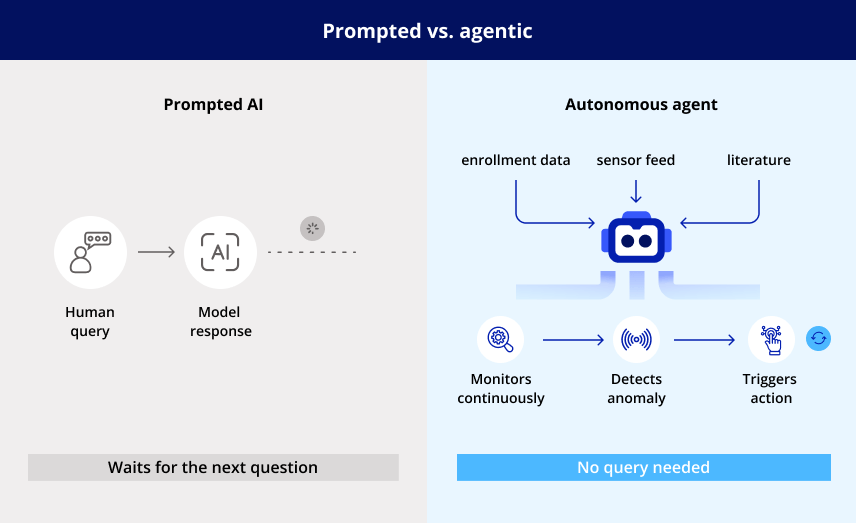
An AI assistant responds when prompted. A scientist asks it a question, and it answers. An autonomous AI agent, by contrast, operates continuously based on inputs from its environment. It does not need a human to initiate every action. The defining quality of agents is that they sense their environment, reason about what they observe, and execute actions in response. They are triggered by events, not by queries.
In a pharmaceutical context, that distinction translates into systems that can monitor a clinical trial in real time and flag an enrollment problem before it delays the study, rather than waiting for a project manager to notice it in a weekly report. It means software that can begin generating a regulatory submission document as data becomes available, not after a data lock months later. Big data in healthcare has made the raw material for this kind of automation available. Agentic AI provides the layer that acts on it.
How Artificial Intelligence in Pharma Got Here
Artificial intelligence in pharma first gained serious traction through pattern recognition tasks where large datasets and defined outputs made machine learning tractable. Predicting protein folding, identifying biomarkers in imaging data, flagging adverse events in pharmacovigilance records were jobs where statistical models could add value without needing to plan, reason, or coordinate across systems.
Generative AI widened what was possible, particularly in scientific writing, literature synthesis, and molecular design. But generative AI still operates on demand. It produces an output when asked and stops there.
Agentic AI represents the next layer of capability. These systems combine the reasoning power of large language models with memory, tool access, and the ability to plan multi-step tasks toward a goal. An agent working on clinical data management does not simply summarize what it finds. It identifies discrepancies, decides which ones are most consequential, triggers resolution queries, tracks responses, and updates its record of the trial’s data quality status. It does this continuously, across thousands of data points, without human instruction for each step.
AI Drug Discovery and the Race to Shorten R&D Timelines
AI drug discovery has attracted the most public attention, and for good reason. The earliest stages of pharmaceutical R&D are defined by combinatorial complexity. The number of theoretically possible drug-like molecules is estimated in the hundreds of billions. No human team can evaluate more than a small fraction of that space. Machine learning models trained on genomic, proteomic, and chemical data can narrow that space substantially, flagging candidates with favorable binding profiles or predicted safety characteristics before a single experiment is run.
Agentic AI takes this further by closing the loop between prediction and action. Autonomous AI agents can not only model which molecule is likely to work but also design the next experiment, submit it to a robotic laboratory platform, collect the results, and refine the model based on what those results reveal. This kind of iterative, closed-loop discovery is moving from pilot to production at a number of large pharma companies.
Predictive analytics in pharma is also reshaping how companies make portfolio decisions. Rather than relying on periodic reviews of pipeline assets, decision intelligence tools can now continuously integrate data from ongoing trials, competitor disclosures, and published literature to assess where capital is best deployed. The result is not just faster science but more disciplined resource allocation.
The McKinsey Global Institute has estimated that AI technologies could generate $60 billion to $110 billion a year in economic value for the pharma and medical-product industries, largely through productivity gains across drug identification, development, and commercialization.
AI-Driven Clinical Trials: Faster, Leaner, More Precise
Clinical development accounts for nearly 70 percent of total pharmaceutical R&D expenses, and it is where most of the time and money is lost. Patient recruitment takes longer than planned. Sites underperform. Data queries pile up. Regulatory submissions stretch across months of manual document preparation.
AI-driven clinical trials are changing each of those bottlenecks. Agents can analyze site performance data to prioritize high-performing locations before a study begins, and monitor enrollment trends in real time to identify sites that are falling behind before delays compound. One large pharmaceutical company has already deployed a multi-agent trial management system that monitors site activation, patient enrollment, and data management in real time, accessing data from a clinical control tower and suggesting interventions when sites underperform.
The data management stage is where some of the most significant efficiency gains are visible. McKinsey’s analysis of pharmaceutical workflows projects 35 to 45 percent time savings across all clinical development functions, with data management and programming productivity potentially increasing by 60 percent and database build timelines reduced from two to three months to under two weeks.
Document generation is another area being transformed. Clinical study reports, protocols, and regulatory dossiers are among the most labor-intensive deliverables in drug development. Agents can begin assembling these documents from standardized data flows as a trial progresses, rather than building them from scratch after data lock. The human role shifts from drafting to reviewing, a change that compresses timelines significantly without compromising accuracy.
AI in Pharmaceutical Manufacturing: Predictive Control on the Plant Floor
AI in pharmaceutical manufacturing operates in a different regulatory environment than R&D, but the operational logic is similar. Production processes are governed by Good Manufacturing Practice (GMP) requirements. Deviations are expensive. Equipment failures can compromise entire batches. Quality control demands documentation at every step.
Predictive analytics in pharma manufacturing applies machine learning to sensor data from production lines to detect early signs of equipment degradation before a failure occurs. Rather than scheduling maintenance on fixed intervals or waiting for a breakdown, agents monitor temperature, pressure, vibration, and other variables continuously and trigger maintenance workflows when anomalies suggest an impending problem. The shift from reactive to predictive maintenance can reduce unplanned downtime significantly and improve overall equipment effectiveness.
In process optimization, autonomous AI agents can adjust critical parameters in real time within defined bounds to maintain product quality as raw material variability or environmental conditions shift. This capability is particularly valuable in biologics manufacturing, where process sensitivity is high, and batch failures carry a large cost.
Quality management in GMP environments also benefits from agentic approaches. Agents can monitor batch records as they are generated, cross-check data against specifications, and flag deviations for human review before they escalate to formal investigations. This reduces the review burden on quality assurance teams while improving the speed and consistency of oversight.
Decision Intelligence as a Strategic Layer
The most sophisticated application of agentic AI in pharma is not in any single function but in the integration across functions. Decision intelligence refers to the use of connected data and reasoning systems to support strategic decisions at the organizational level, not just operational ones.
A pharmaceutical company manages interdependent decisions across drug discovery, clinical development, regulatory affairs, manufacturing, and commercial planning simultaneously. Each domain generates large data that is rarely visible to the others in real time. Decision intelligence platforms built on agentic architecture can aggregate signals from across the value chain and surface them to executives and function heads in a form that supports faster, better-informed choices.
McKinsey’s analysis of the full potential of agentic AI in life sciences found that it could lift pharmaceutical company growth by 5 to 13 percentage points and increase EBITDA by 3.4 to 5.4 percentage points over the next three to five years, with 75 to 85 percent of pharmaceutical workflows containing tasks that agents could enhance or automate.
Those numbers reflect not just individual efficiency gains within functions but the compounding effect of decisions made faster and with better information across an entire enterprise.
Integration with Cloud, Big Data, and IoT Technologies
Agentic AI does not operate in isolation. Its effectiveness depends directly on the data infrastructure available to it. In pharmaceutical environments, that infrastructure typically spans cloud computing platforms, big data analytics pipelines, and IoT sensor networks embedded in manufacturing and laboratory equipment.
Cloud platforms provide the scalability agents need to process large datasets across R&D, manufacturing, and commercial functions without the constraints of on-premise systems. Big data in healthcare (drawn from clinical records, genomic databases, trial registries, and real-world evidence sources) gives agents the depth of signal required to reason accurately rather than generalize from thin inputs. IoT integration in pharmaceutical production adds real-time visibility into physical processes, feeding agents the sensor data that makes predictive maintenance and continuous quality monitoring possible.
For companies building toward enterprise-wide agentic AI, the state of this underlying infrastructure is often the binding constraint. Agents are only as good as the data they can access, and fragmented or poorly governed data environments will limit performance regardless of model quality.
AI Compliance and Regulation: Governing Autonomous AI in Pharma
Deploying autonomous AI agents in a pharmaceutical environment means operating within one of the most stringent regulatory frameworks in any industry. FDA regulations, GMP standards, and guidance from other bodies require that decisions affecting drug development and manufacturing be traceable, validated, and defensible under audit. That requirement applies whether the decision is made by a human or an AI system acting on their behalf.
AI compliance and regulation in this context is not primarily about whether agents are permitted to operate. Most applications of agentic AI in pharma fall well within what regulators allow, provided the governance is sound. The practical question is how to build that governance in from the start. Agents need audit trails that document what data they acted on, what reasoning they applied, and what actions they took. Human oversight needs to be built into workflows for decisions that carry regulatory weight, not added as a checkpoint after the fact.
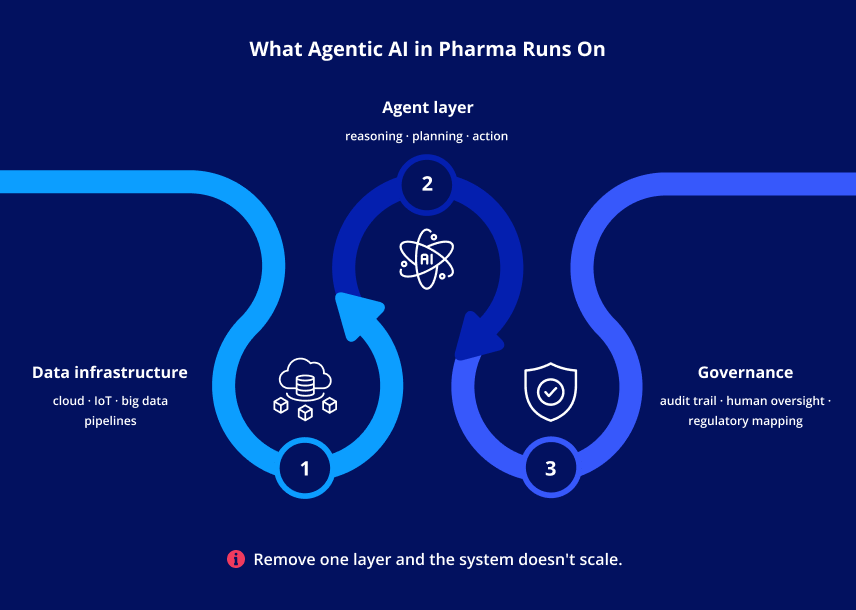
The organizations that navigate this well treat compliance as a design requirement alongside accuracy and cost. Mapping each planned use case to its specific regulatory obligations before development begins, rather than resolving compliance questions during or after deployment, is what separates implementations that scale from those that stall.
The Future of Agentic AI in the Pharmaceutical Industry
The current wave of agentic AI adoption in pharma is concentrated in well-defined operational workflows where data is relatively clean, and the value of automation is demonstrable. The gains in development timelines, manufacturing efficiency, and R&D costs are real and already being captured by early movers. But the trajectory points toward something more fundamental than operational improvement. As agent architectures mature and data infrastructure improves, autonomous AI agents will move further into scientific decision-making. Fully autonomous laboratories, where agents design, execute, and interpret experiments with minimal human initiation, are an active area of development at several research organizations. AI-driven pharmaceutical enterprises, where agents coordinate across discovery, development, and commercial functions in real time, represent a credible medium-term prospect rather than a distant aspiration.
The companies building deliberate, well-governed agentic AI capabilities now are accumulating the organizational learning, data foundations, and institutional trust in these systems that will determine competitive position over the next decade. Agentic AI in pharma is not a single initiative. It is an ongoing capability build, and the time to begin is already here.
FAQ
What is the difference between agentic AI and regular AI in pharmaceutical applications?
Traditional AI tools in pharma, including most analytics dashboards and AI assistants, respond to prompts or queries. They require a human to initiate each interaction and produce an output in response. Agentic AI refers to autonomous AI agents that operate continuously based on triggers from their environment. Rather than waiting to be asked, they monitor data, reason about what they observe, and take or recommend action without step-by-step human instruction. In a clinical trial, for example, a regular AI tool might generate a site performance report when asked. An agentic system would monitor enrollment data continuously and alert a trial manager as soon as a site begins to fall behind, before the delay compounds.
How do FDA and GMP requirements affect the deployment of autonomous AI agents in pharma?
FDA regulations and GMP standards require that decisions affecting drug development and manufacturing be traceable and defensible under audit. For autonomous AI agents, this means any consequential action the agent takes needs a documented record of what data it used, what it concluded, and what it did. It also means human oversight must be built into workflows for decisions that carry regulatory weight. Neither requirement prevents deployment, but both shape how agents should be architected. Companies that build audit trail capabilities and oversight mechanisms into their agent systems from the start avoid the costly compliance remediation that comes from adding governance after the fact.
Where should a pharmaceutical company begin with agentic AI?
The most accessible starting points combine high business value with relatively clean data and clear regulatory precedent. Clinical trial operations monitoring, manufacturing process anomaly detection, and regulatory document generation are areas where several large pharma companies have already moved from pilot to production. AI drug discovery at the molecular modeling stage is another high-value entry point for companies with mature data science capabilities. The practical recommendation is to define a specific operational problem, assess data readiness honestly, understand the applicable regulatory requirements for that use case, and build a contained, well-governed pilot before scaling.
Would you like more information about this topic?
Complete the form below.