

- 1. Growing role of AI in business and everyday tools
- 2. Understanding AI Assistants
- 3. Understanding AI Agents
- 4. Key Differences Between AI Agents and AI Assistants
- 5. Real-World Use Cases: Where Do They Belong in Your Architecture?
- 6. Benefits and Trade-offs: Risk and Governance Considerations
- 7. When to Use AI Agents vs AI Assistants
- 8. FAQ: AI Agents, Assistants, and Automation
- 9. Future Outlook: Summary
The terminology around artificial intelligence is getting crowded, making it hard to scope real technical projects. The bottom line: an AI assistant is a reactive interface built for single-prompt task automation, while an AI agent is an autonomous system that plans and executees complex workflows to reach a specific goal. Deciding which to build shouldn’t depend on market trends, but on your operational bottlenecks and the actual state of your data foundation.
Growing role of AI in business and everyday tools
Most enterprises start their artificial intelligence journey with conversational AI. They deploy chatbots to help employees query HR policies or summarize meeting notes. These tools prove that natural language processing works, but they still rely entirely on a human sitting at a keyboard to drive the process.
Now, businesses want systems that do more than just talk-they want systems that act. This demand is pushing the market toward agentic AI, where the software runs in the background, makes logic-based choices, and executes multi-step processes without waiting for the next human command.
Understanding this shift is the first step to avoiding bloated tech budgets and misaligned project scopes.
Understanding AI Assistants
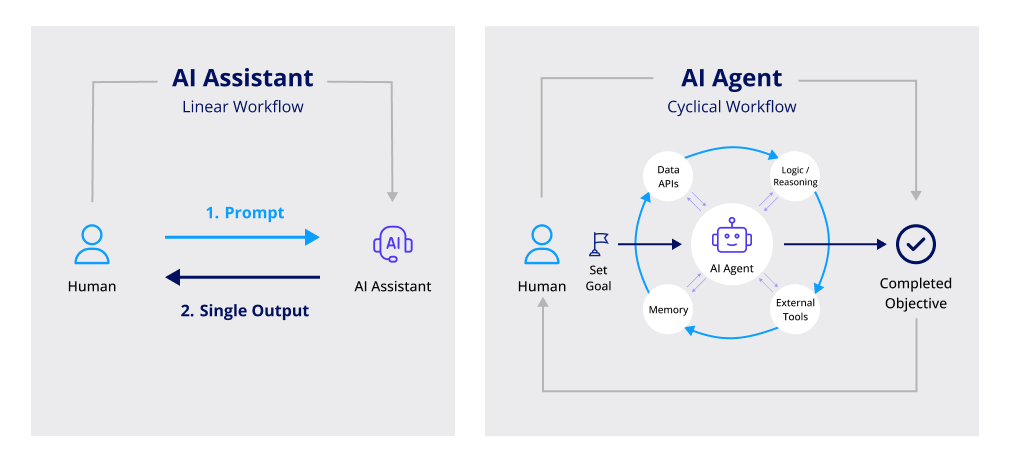
An AI assistant operates strictly on a request-and-response model. You ask it to do something, and it does exactly that one thing. It does not plan for tomorrow, and it does not initiate actions on its own.
Definition and Core Characteristics: Reactive by Design
Think of an assistant as a highly capable digital intern. It can pull data, summarize a dense financial compliance document, or draft an email. However, its context window is short. It focuses only on the immediate prompt.
This makes assistants perfect for straightforward task automation. They lower the technical barrier for employees trying to access complex enterprise systems. If an analyst needs to pull numbers from a siloed database, a well-configured assistant handles the query instantly. To see how these interfaces reduce friction in daily workflows, look at how organizations Transform Interaction with Intelligent Data Chatbots.
Strengths and Usability: Best Fit for AI Assistants
You should deploy an assistant when:
- You want to boost individual employee productivity.
- The workflow requires constant human judgment, empathy, or creativity.
- Your enterprise data architecture is still developing, and you need a low-risk starting point.
Understanding AI Agents
If an assistant is an intern, an AI agent is a specialized project manager. An agent represents a structural shift toward autonomous AI. It is a software system designed to receive a high-level objective, independently break it down into actionable steps, and execute them.
Autonomous Planning, Reasoning, and Execution
The defining trait of an agent is its ability to reason. Let’s say you give an agent the goal: “Optimize the delivery route for fleet X based on current weather patterns, traffic APIs, and vehicle load capacity.” The agent doesn’t just return a static answer. It queries the weather API, checks the traffic database, calculates the load, and then actively updates the routing software. If the weather API drops the connection, the agent recognizes the error, queries a backup data source, and continues its task. This requires long-term state management and memory – something a simple conversational chatbot lacks. For operations that require this level of independence, learning how to Enhance Productivity with Advanced AI Agents is critical.
Key Differences Between AI Agents and AI Assistants
When evaluating AI Agent vs AI assistant for your technology roadmap, the decision usually comes down to four operational realities:
- Autonomy Levels: Assistants wait for user prompts. Agents operate independently once the initial parameters and goals are set.
- Scope of Work: Assistants handle isolated tasks (drafting text, querying a specific dataset). Agents manage macro-level workflows (reconciling end-to-end supply chain discrepancies).
- Interaction Models: Assistants are human-facing. Agents are system-facing, spending most of their time communicating with other enterprise APIs, databases, and software.
Table: Practical Operational Differences: AI Asistant vs AI Agent
| Feature | AI Assistant | AI Agent |
| Primary Goal | Support user directly | Achieve a defined system objective |
| Autonomy Level | Low (Reactive) | High (Proactive) |
| Task Scope | Micro (Single action) | Macro (Multi-step workflows) |
| Error Handling | Stops and asks user for help | Reroutes and tries alternative logic |
| Integration Focus | Internal knowledge bases | External APIs and transactional systems |
Autonomy and Intelligence Levels
The gap between these two technologies is defined by decision-making. Assistants follow explicit instructions. Agents utilize decision-making AI to evaluate options dynamically. As highlighted in recent research – Gartner’s Top Strategic Technology Trends for 2026, the transition toward agentic systems is now a primary focus for enterprise leaders. This shift signals a clear market maturation: businesses increasingly expect their software to independently execute complex processes and deliver measurable outcomes, rather than merely generating conversational content.
Real-World Use Cases: Where Do They Belong in Your Architecture?
To move past the theory, let’s look at how these systems solve actual business problems.
AI Assistants in Customer Support, Content Generation, and Productivity
- Customer Support: Assistants guide human operators during live calls by surfacing relevant technical documentation instantly.
- Corporate IT: Helping developers generate boilerplate code or troubleshoot localized software bugs.
- Legal and Compliance: Summarizing lengthy regulatory changes so human experts can review them faster.
AI Agents in Supply Chain, Pharma, Finance, and IT Operations
Agents belong where data volume and the required speed of action exceed human capacity.
- Logistics: Autonomous agents continuously monitor global shipping data and dynamically reroute cargo to avoid port delays, without waiting for a logistics manager to hit “approve.”
- Industrial Manufacturing: In smart factories, agents analyze real-time telemetry from machinery to predict failures and schedule repairs automatically. You can see this logic applied in IoT in Manufacturing: Smart Factories, Industry 4.0 & Predictive AI.
- Adaptive Systems: The integration of AI into physical hardware relies on agents acting proactively. We explore this heavily in our technical guide: AIoT Explained: How AI and IoT Create Smart, Adaptive Systems.
Benefits and Trade-offs: Risk and Governance Considerations
You cannot build a reliable AI agent on top of bad data. If your enterprise data is siloed, poorly categorized, or full of duplicates, an autonomous system will simply make bad decisions faster than a human ever could.
This is the biggest trade-off. Assistants are safer because a human reviews the output before taking action. Agents execute actions in the background. If an agent hallucinates or accesses biased internal data, it might autonomously order the wrong inventory or misroute a critical shipment.
Therefore, strong data governance, clear role-based access controls (RBAC), and clean APIs are non-negotiable prerequisites. For organizations looking to bridge this gap between raw data and autonomous action, partnering with specialists in AI & NLP Services ensures that the technology doesn’t outpace the infrastructure.
According to experts at the Stanford Institute for Human-Centered Artificial Intelligence (HAI), the next major leap in operational value will come from these agentic systems. But they emphasize that reliability will dictate adoption.
Table: Real-World Applications and Business Impact of AI Assistant vs AI Agent
| Industry | AI Assistant Application | AI Agent Application | Business Impact of Agent |
| IT Security | Summarizes security logs for analysts | Autonomously monitors network, detects anomalies, and applies firewall blocks | Reduced downtime, proactive security |
| Finance | Drafts weekly market summaries | Executes algorithmic trades based on multi-variable analysis | Scalable efficiency |
| Pharma | Organizes clinical trial notes | Simulates molecular interactions to identify viable drug candidates | Accelerated R&D cycles |
When to Use AI Agents vs AI Assistants
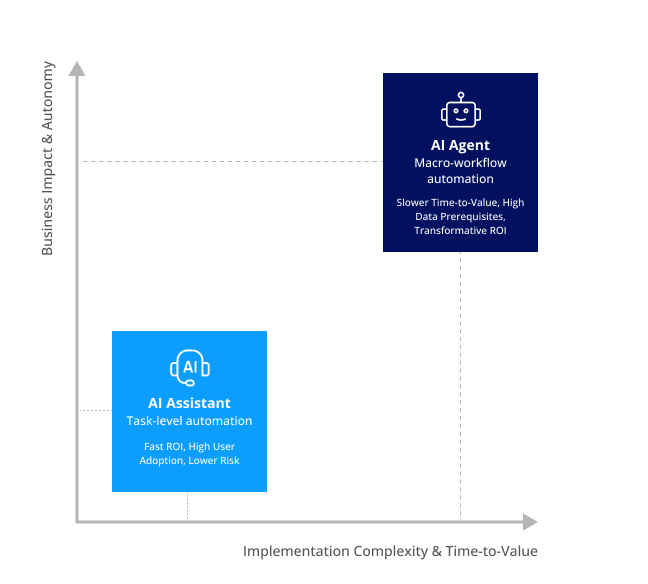
Deciding whether to deploy an AI assistant or an AI agent requires a structured decision framework based on your specific business needs. If your goal is to augment human capabilities, reduce the time spent on repetitive data retrieval, and maintain strict human oversight, an AI assistant is the right choice. However, if your operational bottlenecks involve complex, data-heavy processes that require rapid, autonomous execution across multiple systems without human intervention, investing in an AI agent is justified.
Often, the most effective strategy involves hybrid models combining both approaches. Organizations can deploy assistants for frontline employee support and customer interactions, while simultaneously running autonomous agents in the background to handle backend logistics, data reconciliation, and continuous system monitoring. This combined approach maximizes both immediate productivity and long-term scalability.
FAQ: AI Agents, Assistants, and Automation
1. Is “agentic AI” just another term for Robotic Process Automation (RPA)?
No. RPA follows rigid, pre-programmed rules (if X happens, strictly do Y). Agentic AI uses language models and reasoning to handle ambiguity. If an RPA bot encounters a missing file, it breaks. If an AI agent encounters a missing file, it can logically deduce an alternative database to search or alert a specific team member, adapting to the obstacle to achieve its goal.
2. What are the strict data prerequisites for an AI agent?
An agent requires data to be un-siloed, standardized, and accessible via secure APIs. Because agents act autonomously, inaccurate data leads directly to flawed operational actions. Rigorous metadata management and data hygiene are mandatory before giving any AI system “write” or “execute” privileges in your environment.
3. How do you govern autonomous AI to prevent costly mistakes?
Governance is established through system architecture guardrails. This includes restricting API permissions (e.g., granting the agent “read” access but requiring a human click for “execute” commands), setting strict financial thresholds, and enforcing a “human-in-the-loop” review phase during early deployment until the agent’s logic is proven reliable.
4. Can we upgrade an existing AI assistant into an AI agent?
Usually, no. They represent fundamentally different architectures. An assistant is built to respond; an agent is built to plan, sequence, and manage state. While you can add basic trigger functions to a chatbot, creating a true, reasoning agent requires rebuilding the system around an orchestration framework (like LangChain or AutoGPT) that supports memory and complex tool usage.
5. Which approach offers a faster Return on Investment (ROI)?
Assistants provide a faster, immediate ROI. They are simpler to integrate and immediately reduce the time employees spend retrieving data. Agents have a longer time-to-value due to integration complexity, strict data prerequisites, and rigorous testing. However, once deployed, agents offer a vastly higher long-term ROI by fundamentally scaling and automating expensive operational workflows.
Future Outlook: Summary
The distinction between an AI assistant and an AI agent is ultimately a matter of autonomy and operational scope. Assistants are highly accessible, reactive tools that enhance human productivity by executing prompt-driven tasks. Agents are proactive, autonomous systems capable of reasoning, planning, and executing complex, multi-step workflows with minimal human intervention.
Deciding which technological approach to implement should never be driven by novelty. It requires a clear understanding of your business objectives, operational bottlenecks, and, most importantly, the maturity of your underlying data architecture. By prioritizing strong data governance and establishing a realistic implementation of roadmap, organizations can successfully leverage both assistants and agents to build more efficient, scalable, and data-driven operations.
Would you like more information about this topic?
Complete the form below.