

- 1. From Analytics to AI-Driven Decisions: Why Insights Alone Fall Short
- 2. Core Components of a Decision Intelligence Architecture
- 3. How Big Data and Cloud Analytics Power Decision Models With IoT Data
- 4. Predictive Analytics and Prescriptive Analytics in Decision Intelligence
- 5. Explainability and Governance in Human-in-the-Loop Decision-Making
- 6. Measuring Decision Outcomes and Building a Roadmap
- 7. FAQ
A pharma supply chain planner spots a potential shortage two weeks before it hits. The data is there and the signal is clear. Yet the round of calls and manual checks that follows takes long enough to turn a preventable disruption into an expensive one. The insight arrived on time, but it still had to pass through layers of manual verification before anyone could act on it. In a regulated environment, that lag is structural.
Decision intelligence is designed to address this. It combines analytical capability with decision science so that data goes beyond informing people and actively shapes how choices get evaluated and improved over time.
What makes decision intelligence especially relevant for regulated industries is the constraint environment. Pharma and manufacturing organizations, along with CPG and animal health companies, operate under conditions where every significant decision needs an audit trail and every model output needs an explanation. Speed without traceability creates more risk than it removes.
From Analytics to AI-Driven Decisions: Why Insights Alone Fall Short
Business intelligence (BI) has given most organizations a clear view of what happened and, with some effort, why. It taught companies to trust data and invest in governance. The limitation is that BI surfaces patterns but does not recommend a response or weigh tradeoffs as conditions change.
Commercial analytics has pushed BI further by layering predictive models and real-time market signals onto traditional reporting. Even so, the jump from having a recommendation to operationalizing it at speed, consistently, across a regulated enterprise, is where most organizations stall.
AI-driven decisions encode decision logic directly into the workflow. Decision intelligence systems evaluate options against constraints before recommending or executing actions, with the level of autonomy depending on what the organization permits. The analytical value chain goes beyond a finished report and continues through to a recommended action that accounts for both the data and the regulatory requirements surrounding it.
When decision logic moves into the system, the roles around it evolve. Analysts spend less time interpreting dashboards and more time designing the decision frameworks themselves, while domain experts focus on setting the boundaries within which the system can operate. And in regulated industries, that human factor carries particular weight, because accountability for outcomes stays with the people who defined the algorithm, regardless of how much the system automates.
Core Components of a Decision Intelligence Architecture
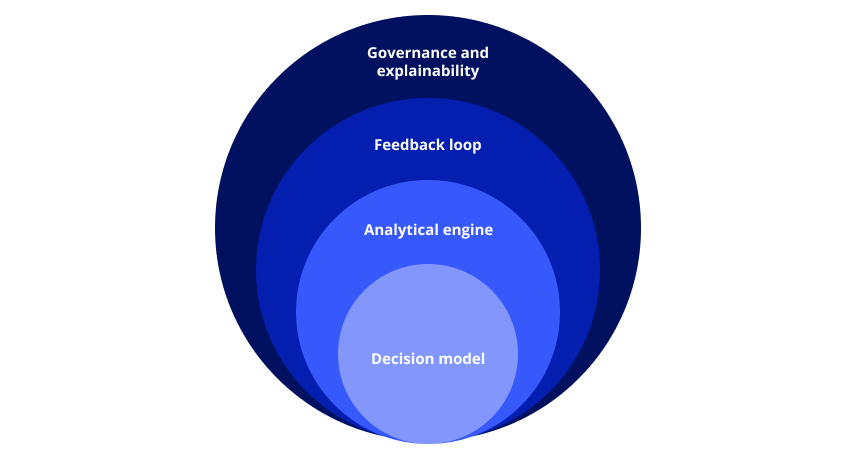
Decision intelligence works as a design pattern that connects several capabilities into a system capable of improving decisions over time. At its core is a decision model, an explicit map of what data a specific decision requires and what rules constrain it, along with how outcomes get measured. Without that layer, organizations end up with AI that generates predictions but no framework for acting on them.
On top of that model sits the analytical engine, typically powered by machine learning, that evaluates scenarios and recommends actions. The critical addition is the feedback loop, where outcomes are tracked against what the model expected. Those comparisons recalibrate future recommendations, and over time, the system learns which decision pathways produce better results under which conditions.
Governance wraps around the entire structure. In regulated industries, every decision that touches compliance or patient safety needs an audit trail. The architecture must log who made the decision, what data informed it, and whether a human reviewed the recommendation before execution. This feature makes AI-driven decisions viable in environments where regulators expect full traceability.
How Big Data and Cloud Analytics Power Decision Models With IoT Data
The right data reaching the right model at the right time is what makes decision intelligence operational. That dependency is where big data infrastructure and cloud platforms become essential, especially when paired with sensor networks feeding real-time signals.
Big data environments provide the historical depth that decision models need to learn from. Pattern recognition in manufacturing quality and demand variability in CPG supply chains both require large volumes of structured and semi-structured data to reach statistical significance. Without that depth, predictive models underperform and prescriptive recommendations lack confidence.
Cloud analytics platforms add the scalability that on-premises infrastructure struggles to deliver. Elastic compute makes it feasible to retrain models frequently and run scenario simulations at scale while serving recommendations in near-real-time. For organizations operating across multiple sites, cloud also simplifies the challenge of keeping decision models consistent while adapting them to local conditions.
IoT data introduces a different dimension entirely. Sensor readings from production lines and environmental monitors in warehouses generate continuous streams that allow decision models to respond to conditions as they emerge. Field equipment in animal health operations adds another layer of real-time signal. When IoT data flows into a well-designed decision architecture, the gap between sensing a change and acting on it shrinks from days to minutes.
Predictive Analytics and Prescriptive Analytics in Decision Intelligence
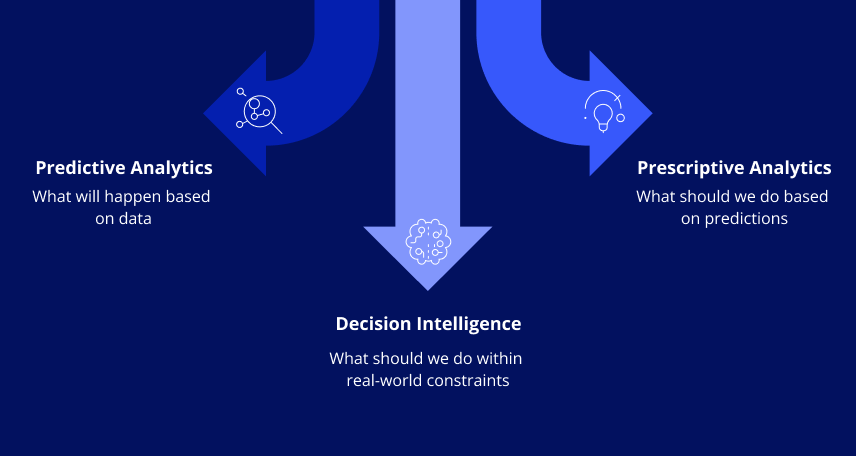
Predictive analytics answers the question of what is likely to happen. Prescriptive analytics goes further and recommends what to do about it. Decision intelligence depends on both, but it also evaluates recommendations against business rules and regulatory constraints before anything is executed.
Consider a demand forecasting model in a CPG organization. Predictive analytics can estimate that demand for a product category will spike next quarter. Prescriptive analytics can recommend increasing production and reallocating inventory. Decision intelligence assesses if the production increase is feasible given current supplier contracts and if the inventory reallocation complies with shelf-life regulations. It turns a statistical forecast into a decision that accounts for the full context of the business.
Such contextual evaluation is essential in regulated environments. A predictive model might flag an anomaly in a pharma production batch. A prescriptive layer might recommend halting the line. Decision intelligence determines whether the anomaly falls within acceptable variance under current GMP guidelines and who needs to be notified. It also identifies what documentation is required before any action is taken. So, its true value lies in the ability to act on predictions responsibly and fast.
On top of that, AI-Powered Analytics capabilities make this integration possible at enterprise scale. When predictive and prescriptive models operate within a governed decision framework, they stop being experimental tools and start becoming operational infrastructure.
Decision Intelligence in Manufacturing and CPG
Manufacturing generates enormous volumes of operational data, and the decisions that data informs are both frequent and consequential. Line speed adjustments and quality hold-or-release calls happen continuously across shifts and sites. So do maintenance scheduling and inventory rebalancing. Most are still made by experienced operators relying on localized knowledge and standard procedures.
Decision intelligence changes the scale at which those operational decisions can be optimized. A McKinsey survey of more than 100 manufacturing COOs found that 93 percent plan to increase their digital and AI spending over the next five years, with predictive maintenance and process optimization leading the list of priority use cases. The challenge, as that same research highlights, is that most companies have yet to move beyond pilot stage. Only 2 percent reported AI fully embedded across all operations. That disconnect between investment intent and operational reality is where decision intelligence architectures add the most value, because they connect individual AI models into decision workflows that can actually scale.
In CPG, the decisions shift toward demand and channel dynamics. Forecasting accuracy and promotion effectiveness both benefit from predictive analytics layered into decision frameworks, as does inventory positioning across channels. IoT data from distribution networks and retail environments adds the real-time signal that static forecasting models miss. When cloud analytics platforms connect these data streams to a governed decision framework, CPG organizations can move from reactive adjustments to anticipatory planning. The difference shows up in reduced stockouts and better margin management.
Decision Intelligence in Pharma and Animal Health
Pharma operates under regulatory scrutiny that makes every AI-driven decision a documentation event. Batch release decisions and deviation management each carry compliance weight that demands full traceability. This creates a natural tension. The speed advantage that AI-driven decisions can offer is valuable only if the audit trail keeps pace.
McKinsey has estimated the opportunity for generative AI in biopharma operations at $4 billion to $7 billion annually, spanning production efficiency and supply chain optimization. The supply chain use case is particularly relevant to decision intelligence. Pharma supply chains generate fragmented data across supplier databases and production systems, leading to limited visibility into stock levels and delivery performance. An integrated decision platform consolidates those data streams and provides planners with scenario analyses that improve both speed and quality of response.
Animal health shares many of the same manufacturing and supply chain dynamics as pharma, combined with field-level data collection from veterinary operations and livestock management. Decision intelligence in animal health means connecting production quality signals with field outcome data to improve forecasting and compliance decisions. The regulatory environment is different in degree from human pharma, but the principle holds. Every AI-assisted recommendation in animal health still needs to be explainable to auditors and aligned with sector-specific quality standards.
Predictive analytics plays a distinct role in both sectors. In pharma, it supports early detection of process drift. In animal health, it helps forecast seasonal demand patterns. Decision intelligence connects these predictions to governed action rather than leaving them as insights on a dashboard.
Explainability and Governance in Human-in-the-Loop Decision-Making
In regulated industries, an AI recommendation that cannot be explained is an AI recommendation that cannot be used. Regulators expect organizations to demonstrate why a decision was made and what data informed it. Research from MIT Sloan highlights several characteristics that make AI programs difficult for stakeholders to trust, including model opacity and the risk of mindless application. Building explainability into the decision intelligence architecture from the start addresses both concerns.
Explainability takes different forms depending on the decision type. For high-frequency operational decisions, it may mean logging the input variables and the model’s confidence score. For high-stakes decisions with compliance implications, it requires a full decision trace showing which rules were applied and how the recommendation ranked against alternatives. Prescriptive analytics models are particularly sensitive here, because they do more than predict. They recommend action, and any recommendation that affects product quality or patient safety needs to be defensible under audit.

Why Enterprises Should Treat Data Like a Living Organism
An in-depth conversation on how pharma organizations can treat data like a living organism and build healthier, AI-ready data environments through strong foundations, governance, and organizational…

Analytical Report Creation and the Cost of Analysis
Learn how to design analytical reports that balance business goals with usability. Explore strategies to make reporting and analytics more impactful.
Human-in-the-loop governance determines the boundary between augmented and automated decisions. Some decisions can be fully automated when the risk is low and the rules are clear. Routine inventory replenishment in a CPG warehouse is a reasonable candidate. A batch release decision in pharma is not. Decision intelligence architectures encode these boundaries explicitly, defining which decisions require human approval and which can proceed autonomously. Getting this calibration right is as important as the AI models themselves.
Measuring Decision Outcomes and Building a Roadmap
Decision intelligence creates value only when it demonstrably improves the decisions it was designed to support. That means measurement cannot be an afterthought. Organizations need to define what a good decision looks like before the system is live and track how actual outcomes compare to model expectations. The decision logic then gets refined based on what they learn.
McKinsey’s 2025 State of AI survey found that 88 percent of organizations are now using AI in at least one business function, but only 39 percent report measurable enterprise-level EBIT impact. The reason is often surprisingly basic. Organizations deploy AI models without establishing clear baselines or attributing outcomes to specific decision changes.
A practical roadmap starts with identifying the decisions that matter most, be it quality hold-or-release calls in manufacturing, deviation management in pharma, or promotional spend allocation in CPG. From there, the work is mapping those decisions against existing data infrastructure. Where the data is strong and the decision logic is well understood, decision intelligence can deliver results quickly. Where the data is fragmented, the groundwork comes first.
The organizations that move fastest tend to start with a single high-value decision domain and prove the model works before expanding. That incremental approach respects the regulatory reality. Deploying decision intelligence at enterprise scale without first validating it in a controlled environment would be irresponsible. The discipline of starting small and scaling deliberately is a feature of the approach.
FAQ
What makes decision intelligence different from traditional business intelligence?
Business intelligence focuses on reporting what has happened and why. Decision intelligence goes further by encoding decision logic and evaluating options against constraints before recommending or executing actions. The key addition is the feedback loop. BI delivers a report. Decision intelligence delivers a recommendation and tracks the outcome. It then feeds that outcome back into the next recommendation cycle.
Why is explainability especially important for decision intelligence in regulated industries?
Regulated industries face audit requirements that demand traceability for every significant decision. When an AI system recommends a batch release or flags a supply chain disruption, regulators expect the organization to demonstrate what data informed the recommendation and what rules governed it. Explainability is what makes AI-driven decisions defensible under those conditions. Without it, organizations take on regulatory risk every time they act on an automated recommendation.
Where should organizations start when building a decision intelligence capability?
The most effective starting point is a single high-value decision domain where the data is strong and the decision rules are well understood. Manufacturing quality decisions and pharma deviation management are common entry points, as is CPG demand forecasting. Starting with a focused scope allows the organization to validate the architecture and demonstrate measurable outcomes before expanding to more complex or higher-risk decision areas.
Would you like more information about this topic?
Complete the form below.