

It would be a truism to say that modern organizations operate in very dynamic conditions. Today, decision-makers are faced with unprecedented complexity and data volumes. In the last two decades, organizations have built large systems to collect and process data. However, as market research and our own experience show, stakeholders are often unable to process all this information or have difficulty interpreting indicators. To say it plainly: a large portion of the data doesn’t support the decision-making process. Traditional analytical methods are insufficient to take quick and accurate actions.
Those circumstances lead to rise new research, managerial and technology field: Decision Intelligence.
In this context, we can define Decision Intelligence (DI) as a practical discipline that combines advanced analytics, artificial intelligence, and behavioral and economic sciences to close the gap between insights and actions.
The main benefits of building a Decision Intelligence ecosystem in an organization are:
- The combination of a decision with taking an action, which leads to the problem of translating indicators into specific actions and their execution,
- Greater utilization of the data we have, which ultimately leads to better decisions,
- Far-reaching automation, which drastically reduces the time from strategic suggestions to action.
An important element of decision intelligence are feedback loops, which allow for systematic improvement of the system over time. In Gartner’s 2025 AI Hype Cycle report, DI has been indicated as a transformative technology capable of fundamentally changing the way enterprises design, execute, and optimize decision-making processes.
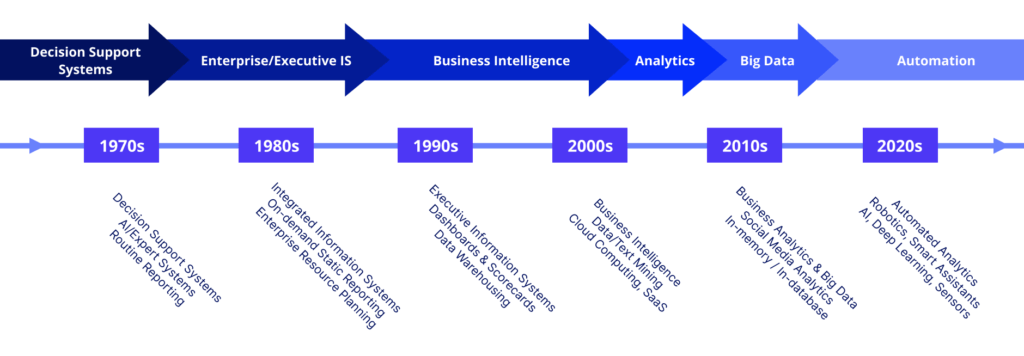
Decision Intelligence: A Brief History
InTo better understand what Decision Intelligence is, it is worth tracing the history of how decision support systems were developed in the first place.
- Beginnings
The foundations for modern decision-making disciplines were laid in the 50s and 60s of the twentieth century. The pioneering work of Herbert Simon at the Carnegie Institute of Technology allowed for the modeling of decisions as processes consisting of the phases of intelligence, design, and choice. During the same period, operations research and linear programming were developing.
In academia, Michael S. Scott Morton is considered to be the father of the concept of Decision Support Systems (DSS), who in 1964 formulated the basics of using computers to support managers in solving poorly structured problems. In the 1970s, theorists such as Peter Keen and Scott Morton defined DSS as interactive systems that do not replace the decision-maker, but strengthen their judgment through access to data and analytical models.
- Expert systems and decision modeling
The 1980s were characterized by the transition to tools that allowed business users to conduct “what-if” analyses on their own. At the same time, the “second golden age of artificial intelligence” was developing – the time of expert systems that tried to codify the knowledge of specialists in the form of rules and inference, constituting the first mass step towards the application of AI in business. In the 1990s, the concept of a data warehouse was developed, which enabled systematic access to historical information on an enterprise-wide scale and laid the foundations for modern reporting systems.
The 21st century is the democratization of decision-making based on collected data. Quantitative analytics began to be treated as a key competitive advantage.
- The birth of Decision Intelligence
The term Decision Intelligence was only formalized in 2012 by Lorien Pratt and Mark Zangari, who combined analytics with engineering modeling and behavioral sciences.
Decision Intelligence vs. Traditional Approaches: DSS, BI and AI
IIt’s a common mistake to treat Decision Intelligence only as a new name for Business Intelligence (BI) or Artificial Intelligence (AI). DI represents a significant paradigm shift from data-centric to decision-centric systems.
What Does This Mean in Practice?
Traditional BI focuses on retrospective analysis: “What happened?” (historic data) and “Why did this happen?” (causal analysis). Despite massive investments in dashboards and visualizations, it is estimated that decision-makers use only 22% of the insights they receive, and about 60% of investments in data infrastructure are wasted due to a challenge of translating analytics into actions. DI reverses this process: instead of starting with data collection, it starts by modeling the decision itself and determining what action will bring the desired business outcome.
Decision Support Systems from the other side were designed as focused tools, assisting the manager in a specific, often isolated choice. In contrast to this, DI is a systemic discipline, helping organizations make and execute decisions on a massive scale. Modern DI also goes beyond DSS in terms of complexity. AI built into decision-making systems allows for the processing of massive data sets in real-time, identifying correlations and trade-offs that are imperceptible to the human eye.
Table 1: System comparison: BI, DSS and Decision Intelligence.
| Feature | Business Intelligence (BI) | Decision Support Systems (DSS) | Decision Intelligence (DI) |
| Objective | Data and indicators (KPIs) | Specific decision-making problems | A holistic decision model as a business process |
| Approach | Data-first | Interactive modeling | “Decision-back” (from goal to data) |
| Time range | Historical (flashback) | Present (choice support) | Continuous (feedback and adaptation) |
| The role of a human | Interpretation of reports | The final choice (human-in-the-loop) | System architect and process orchestrator |
| End result | Dashboard, report | Recommendation, scenario analysis | An action taken or an automatic policy change |
Who Decision Intelligence Is For?
Decision Intelligence is aimed primarily at organizations that operate in complex ecosystems and make thousands of decisions, where even a small improvement in efficiency translates into millions of dollars in profit or savings. For example: decisions about marketing campaigns organization, next best actions, supply chain optimization, supply chain risk management, business risk management, manufacturing planning, and more.
Primary target groups include:
- Business leaders and strategists: they are looking for ways to reduce the risk of making wrong decisions in conditions of market uncertainty. DI provides them with the tools to simulate the effects of strategic choices before they are made.
- Operations and supply chain managers: they need systems that integrate data from multiple sources (IoT, ERP, external markets) and provide contextual recommendations in real-time.
- Risk and compliance professionals: DI allows them to map their expertise to automate risk assessments and ensure consistency of decisions in regulated markets.
Market and the Future of Decision Intelligence (2025–2035)
Analyst forecasts that within coming decade DI ecosystems will become the digital foundation of the enterprise operations. In its research, Gartner estimates that DI adoption is currently between 5% and 20%. However, companies are very actively investing in the individual components of the Decision intelligence ecosystem and it is estimated that the market will reach maturity in the next 2-5 years.
An important factor enabling the rise of decision-making ecosystems is the AI agentic architecture. It is predicted that in the next year, up to 50% of business decisions will be assisted or automated by AI agents, and 40% of enterprise applications will have agentic automation.
Barriers and Challenges
Despite optimistic forecasts, there are also important challenges to have in mind:
- Data availability: appropriate data platforms and data management processes so that DI systems can use them effectively,
- Integration complexity: significant time and resources are needed to connect DI to existing infrastructure,
- Organizational culture: fear of losing control by management and lack of trust in AI “black boxes”.
To overcome these barriers, it’s best to work with a trusted vendor and implementation partner. Hands-on experience in building data-intensive systems and embedding them into day-to-day operations is really helpful in dealing with the common challenges.
From our experience, many of these challenges are similar to those seen in AI initiatives: data readiness, integration complexity, and building trust in automated or semi-automated decisions. Teams that have experience with AI projects are often better prepared to address them, both technically and organizationally.
A strong partner helps navigate these areas end to end: from aligning data foundations and integrating with existing systems, to supporting change management and training users. The goal is not to introduce another tool, but to enable a real shift in how decisions are made and executed across the organization. organization.
Strategic Recommendations
Decision Intelligence is a practical response to the challenges businesses face when operating in the age of Big Data. It builds on existing investments in data and analytics, but shifts the focus toward what matters most: making better decisions and turning them into consistent action.
Instead of concentrating on collecting and analyzing more data, DI helps organizations structure decisions, connect them to data that can support it, facilitate execution, and continuously improve outcomes over time. This leads to better use of data, faster response times, and more predictable results.
For many organizations, this is no longer an optional layer. As decision-making becomes more complex and time-sensitive, Decision Intelligence is becoming part of the operational foundation, especially in areas where speed, scale, and consistency directly impact performance. .
FAQ
Where should you start with Decision Intelligence?
Start with a specific, high-impact decision area. Look for processes where decisions are frequent, data is available, and outcomes are measurable: such as pricing, supply chain planning, or next-best-action in sales. From there, you can design a repeatable decision model and expand it over time.
How is Decision Intelligence different from traditional decision support systems (DSS)?
DSS tools typically support individual decisions in isolation. Decision Intelligence takes a broader approach; it treats decisions as scalable, repeatable processes, integrates them across the organization, and includes feedback loops to continuously improve outcomes.
What are the main challenges in adopting Decision Intelligence?
The most common challenges are data readiness, integration with existing systems, and organizational adoption. These are similar to challenges seen in AI projects, especially around trust in automated recommendations and aligning business and data teams.
Do I need to replace your existing data platform to implement DI?
No. Decision Intelligence builds on top of your existing data and analytics investments. The goal is not to replace your current tools, but to better connect them and ensure they lead to consistent, actionable decisions.
Would you like more information about this topic?
Complete the form below.