

When structured e-invoicing becomes mandatory, most organizations focus on compliance. The bigger opportunity is to use it to improve how invoices, purchase orders, and budgets work together.
Project Bridge is C&F’s cloud-native solution built on OutSystems Developer Cloud (ODC) that connects e-invoices directly to your financial processes, ownership, and approvals.
While the initial implementation was driven by Poland’s National e-Invoicing System (KSeF), the same shift is happening across Europe. Similar frameworks are already in place or coming soon in multiple countries.
The Bigger Picture: e-Invoicing as a Structural Shift
Across the EU, e-invoicing is becoming standardized and mandatory. This changes how data enters your organization in a very practical way.
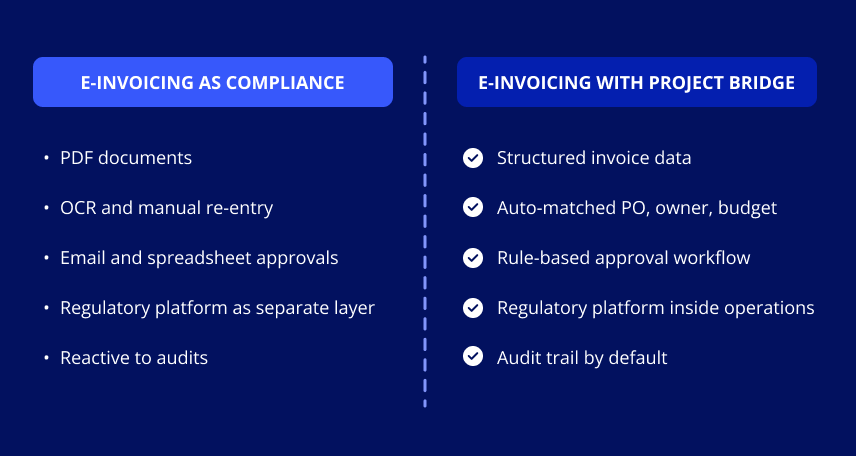
Instead of dealing with unstructured documents, you receive invoices as structured data that is immediately available and ready to use. There is no need for Optical Character Recognition (OCR) or manual re-entry, and regulatory platforms become part of your day-to-day operations rather than a separate layer.
For you, this creates a clear opportunity: invoice data can flow directly into your internal processes, without additional interpretation or delay.
The Challenge to Solve
To take advantage of that shift, you need to rethink how invoices connect to the rest of your financial workflow.
In practice, this means making sure every invoice is linked to the right owner, purchase order, and budget, while replacing email-based and spreadsheet-driven processes with something more controlled and auditable. At the same time, approval rules need to be enforced without slowing the process down, and everything has to stay aligned with your ERP system.
Instead of adding new tools on top of existing processes, we redesigned the flow end-to-end so that these elements work together by design.
Why OutSystems ODC
OutSystems Developer Cloud (ODC) gave us a way to build this quickly while keeping the solution flexible.
It supports fast development through reusable components and makes it easier to integrate with ERP systems and e-invoicing platforms through APIs. At the same time, it provides built-in mechanisms for access control, auditability, and workflow automation.
This means you can adjust approval rules, budget structures, or process logic without disrupting daily operations. The result is a setup that works today and can evolve as regulatory requirements change.
What Project Bridge Does
Project Bridge connects structured e-invoices with your internal financial processes in real time. It brings together e-invoicing, purchase order management, and cost control into a single flow. Instead of handling these areas separately, they are aligned from the moment an invoice enters the system.
Because the data is already structured, invoices can be automatically linked to a purchase order, assigned to the right owner, and mapped to the correct budget and cost center. This removes the need for manual matching, reduces errors, and shortens approval cycles.
Mobile-First Purchase Orders
We also simplified how purchase orders are created. Budget owners can raise POs from any device using structured templates, with the system handling identifiers, required data, and approval routing in the background. This keeps the process fast and accessible, without losing control over how requests are created and approved.
A More Transparent Financial Workflow for e-Invoicing
When invoices, purchase orders, and budgets are connected, you get a much clearer view of your spending. Finance teams no longer need to chase documents, and managers don’t have to reconcile data manually. Each cost is traceable from the initial request through to final settlement, which makes it easier to monitor budgets and respond when something changes. This shift is less about adding new features and more about removing friction from existing processes.
Designed for a European Context
Although this started with KSeF, the same direction is visible across Europe. Countries like Italy, Romania, and France are introducing or expanding similar e-invoicing models, and requirements will continue to evolve.
Project Bridge was designed with this in mind. Its modular structure and configurable rules allow you to adapt the solution to different regulatory environments without rebuilding it from scratch.
Business Outcomes
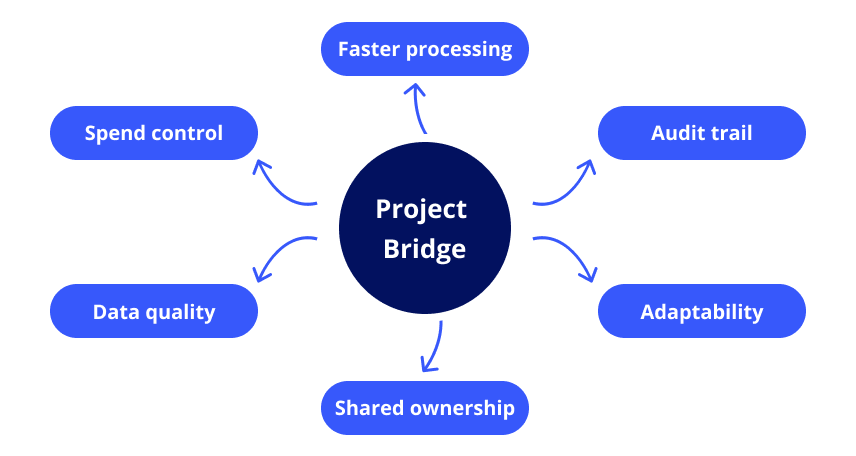
In practice, this approach gives you stronger control over spending, because purchase orders, invoices, and budgets are clearly linked. Processing becomes faster as manual steps are removed, and data quality improves thanks to structured inputs
At the same time, you gain full auditability, with every step tracked and aligned with both internal policies and external requirements. Teams work on the same data with clear ownership, which improves coordination across finance and business functions
Just as importantly, the solution remains adaptable, so you can respond to regulatory changes or new business needs without major rework.
What This Means for You
E-invoicing doesn’t have to be just a compliance exercise.
If you connect it directly to your internal processes, it becomes a practical way to improve cost control, simplify operations, and make better use of your financial data.
Project Bridge shows how to make that shift by turning structured invoice data into a working part of your financial workflow.
FAQ
Is this just about complying with KSeF, or something broader?
KSeF may be the immediate trigger, but the shift is much broader. Structured e-invoicing is becoming standard across Europe, and the real value comes from using that data inside your financial processes, not just sending invoices to a regulatory platform.
Do we need to replace our ERP system to use Project Bridge?
No. Project Bridge is designed to work alongside your existing ERP. It connects to your current systems through APIs, so you can extend and improve your processes without a full replacement.
How is this different from standard e-invoicing solutions?
Most e-invoicing solutions focus on sending and receiving compliant invoices. Project Bridge goes further by connecting invoice data directly to purchase orders, budgets, and approvals, so it becomes part of your operational workflow.
Will this slow down approvals or add more control layers?
Quite the opposite. Approval rules are enforced automatically based on predefined logic, which removes manual steps while keeping control. The goal is to make approvals faster and more consistent, not more complex.
What happens if our processes or regulations change?
The solution is designed to be flexible. You can adjust workflows, approval rules, or budget structures without rebuilding the system, which makes it easier to respond to both internal changes and new regulatory requirements.
Can this work outside of Poland?
Yes. While the initial implementation was aligned with Poland’s KSeF, the solution is built to support different regulatory models across Europe. It can be adapted to local requirements without starting from scratch.
Would you like more information about this topic?
Complete the form below.