

- 1. What Is Demand Sensing and Where Does It Fit in CPG Planning?
- 2. How Demand Forecasting Supports Long-Range CPG Decisions
- 3. Why Demand Sensing Depends on Data You Don’t Fully Control
- 4. Demand Sensing vs. Demand Planning: Where the Human Decision Sits
- 5. How AI Is Changing CPG Demand Forecasting, and What It Leaves to Planners
- 6. Where to Start: Measure the Gap Between Signal and Action
- 7. FAQ
In many CPG organizations, demand sensing vs demand forecasting is framed as a choice between an older method and a newer one. But the two actually cover different time horizons. A demand forecast projects volumes months ahead from sales history and planned activity, and it supports capacity, procurement, and budget decisions. Demand sensing adjusts the next few weeks using signals that arrive after the forecast is set, such as retail point-of-sale data or retailer stock levels, and it supports deployment and replenishment.
Framing them as alternatives has practical consequences. It is how companies end up with a sensing tool nobody acts on, or a long-range forecast expected to deliver a precision it was never built for.
What Is Demand Sensing and Where Does It Fit in CPG Planning?
The closer planning gets to execution, the more recent demand signals matter alongside historical patterns. Demand sensing accepts that and works on a short horizon, usually days to a few weeks, using signals that appeared after the forecast was made. Typical inputs include retail point-of-sale data, retailer inventory and stock-outs, open orders, weather, promotions as they were actually executed, and local events. The output is an adjusted near-term view at SKU and location level.
The core change is cadence. When researchers at the MIT Center for Transportation & Logistics studied demand sensing at a large healthcare products manufacturer, the main shift they described was moving from a roughly monthly forecast cycle to weekly or daily updates. They also noted that results vary by company, and that “the main discriminator is the quality of the additional data sets”. The pandemic tested the same idea at scale. McKinsey reported that consumer goods leaders tightened planning cycles from monthly to weekly and brought in external data such as point-of-sale data, retailer stock-outs, weather projections, and cell phone location data.
Demand sensing tells you how reality is drifting from the plan, early enough to do something about it.
How Demand Forecasting Supports Long-Range CPG Decisions
Capacity, materials, and budgets are committed months ahead, and that is the job of demand forecasting. It projects demand over a horizon of several months to a year or more, based on sales and shipment history, seasonality, pricing, the promotional calendar, distribution changes, and new launches. Its output usually sits at product family, region, and month level, because that is the level at which a company decides whether to add a shift, sign a co-packing contract, or buy packaging with a long lead time.
A sensing signal cannot answer those questions. A two-week spike in one region says very little about whether a line needs expanding next year. The opposite is also true: a good annual forecast says nothing about which distribution center should receive tomorrow’s trucks. The table below sets the two side by side:
| Dimension | Demand forecasting | Demand sensing |
| Core question | What will demand look like over the coming months? | How is demand moving right now, and what does that mean for the next few weeks? |
| Typical horizon | Several months to 18+ months | Days to a few weeks |
| Main inputs | Sales and shipment history, seasonality, planned promotions, pricing, launches | Retail POS, retailer inventory and stock-outs, open orders, weather, executed promotions |
| Update cadence | Monthly or quarterly | Daily or weekly |
| Granularity | Product family, region, month | SKU, location, day or week |
| Decisions it feeds | S&OP, capacity, procurement, budgets, trade spend | Deployment, replenishment, allocation, short-term production changes |
| Typical failure | Misses sudden shifts between cycles | Overreacts to noise when signal quality is poor |
Why Demand Sensing Depends on Data You Don’t Fully Control
The signals that make demand sensing useful mostly sit outside your own systems. Retailers share point-of-sale and inventory data on their own terms, with their own latency, item codes, and store hierarchies. Some share daily, some weekly, some not at all. Before any model sees the data, someone has to map retailer items to your SKUs and stores to your distribution network. Those mappings drift as assortments change.
Then comes noise. A sensing model that reacts to every blip creates churn in deployment plans and erodes planner trust within weeks. Teams need explicit rules: how large a deviation must be before it overrides the baseline, for which products, and who approves it.
The physical supply chain sets another limit. If your production schedule is frozen for three weeks and your sensing horizon is two, a sensed change can only move existing stock between locations. Matching the sensing horizon to the decisions your supply chain can still change is one of the first design choices to settle.
Demand Sensing vs. Demand Planning: Where the Human Decision Sits
Much of the confusion comes from a third term. In the demand planning vs demand forecasting comparison, the forecast is an analytical output: the statistical baseline. Demand planning is the business process that turns the statistical baseline into an agreed demand plan by incorporating commercial inputs, assumptions, constraints, and accountability.
Demand sensing vs demand planning is therefore a question of where adjustments land. Sensing works best when it feeds execution (deployment, allocation, replenishment) and leaves the consensus plan intact. When short-term sensed corrections quietly overwrite the agreed monthly number, sales and finance lose the stable reference they plan against. A clean handoff helps: the plan sets the frame, sensing adjusts within it, and large persistent deviations go back into the next planning cycle as an input.
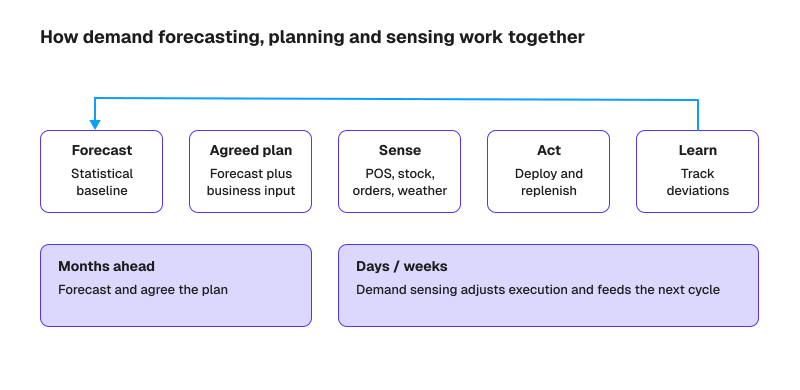
The forecast and the agreed plan set the frame for the coming months. Demand sensing adjusts execution within that frame and sends persistent deviations back into the next planning cycle.
How AI Is Changing CPG Demand Forecasting, and What It Leaves to Planners
AI demand forecasting matters for both horizons, for different reasons. On the long horizon, machine learning models can account for many interacting drivers at once: promotion effects that are not linear, cannibalization between SKUs, price elasticity that varies by channel. On the short horizon, AI is what makes demand sensing practical. No planning team can manually review thousands of SKU and location combinations against daily retailer feeds.
The question of how automation can improve CPG demand forecasting has a less glamorous answer than most vendors suggest. The biggest gains often come from automating data ingestion and cleansing, and from exception-based planning, where planners review only the items that fall outside agreed tolerance. That frees time for the decisions that still need judgment: new launches with no history, one-off retailer events, and supply constraints the model does not know about. For a deeper look at how AI agents work across forecasting and the wider supply chain, see our article on agentic AI in CPG supply chain and demand forecasting.
None of this removes the prerequisites. A model is only as reliable as the data foundation beneath it, and planners will not act on outputs they cannot explain.
Where to Start: Measure the Gap Between Signal and Action
In our experience, the most useful first step is to measure how long your organization takes to act on a signal. Pick one category where you receive reasonably good retailer data and trace a recent disruption. When did the signal first appear in the data? When did someone notice it? When was a decision made, and when did the supply chain act? We call that interval Decision Latency, and our Decision Intelligence whitepaper for CPG describes how to measure it.
If the delay sits mostly between noticing and deciding, better sensing will not help much. The fix lies in decision rights and workflow. If it sits between the signal and noticing, demand sensing is a strong candidate. Either way, a narrow pilot surfaces the data mapping and governance questions early, when they are still cheap to resolve. This is the logic behind our approach to Decision Intelligence: connect signals to specific decisions first, then scale what works across categories and markets.
FAQ
What is demand sensing in CPG?
Demand sensing is a short-horizon method that updates the near-term demand view, usually days to a few weeks ahead, using recent signals such as retail POS data, retailer inventory, open orders, and weather. In CPG it mainly supports deployment, allocation, and replenishment decisions at SKU and location level.
How is demand sensing different from demand forecasting?
Demand forecasting projects demand months ahead from historical patterns and planned activities, and it supports capacity, procurement, and budget decisions. Demand sensing corrects the next few weeks based on what is happening now. The two work best together, with the forecast setting the baseline and sensing adjusting execution within it.
Demand planning vs. demand forecasting: are they the same thing?
No. Forecasting produces the statistical baseline. Demand planning is the cross-functional process that reviews that baseline, adds commercial knowledge and constraints, and agrees on the number the business commits to.
How can automation improve demand forecasting in CPG?
Automation helps most when it removes manual data work and lets planners focus on exceptions. Automated ingestion of retailer data, regular re-forecasting, and tolerance-based alerts reduce the time between a signal and a decision. Judgment is still needed for launches, unusual events, and supply constraints.
The costliest forecasting problem in CPG is often a signal that reaches the right person too late to change anything. Seeing demand sensing and demand forecasting as two tools for two horizons is a practical starting point for fixing that, and it is a conversation we are always glad to have with CPG teams.
Would you like more information about this topic?
Complete the form below.