

- 1. Business Intelligence in CPG Shows What Happened
- 2. Decision Intelligence in CPG Starts From the Decision
- 3. What a Decision Intelligence Platform for CPG Supply Chain Planning Needs to Do
- 4. Decision Governance and Auditability in Regulated Industries
- 5. Where to Start: Keep the BI, Pick One Decision
- 6. FAQ
Business intelligence is the system CPG companies already trust. It took years to build the data warehouse, agree on what counts as a shipment or a promoted unit, and get category, sales, and supply chain teams looking at the same numbers. So when decision intelligence enters the conversation, the first reaction is often suspicion that it is the same dashboards under a new name.
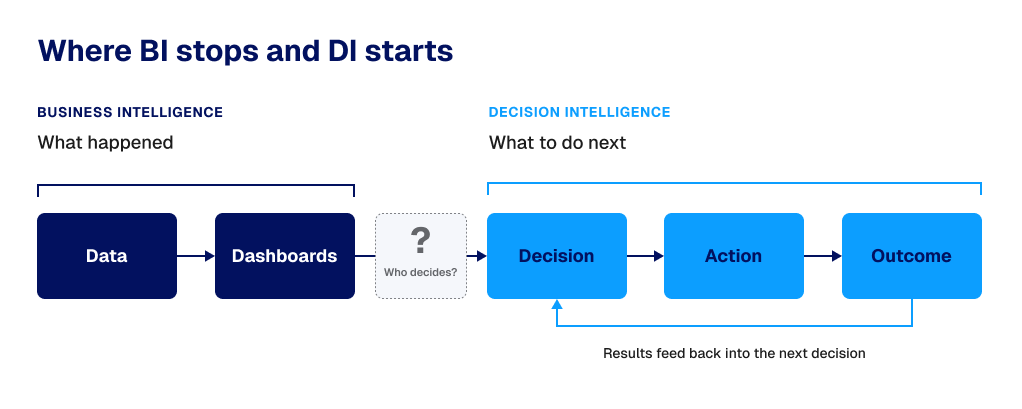
The decision intelligence vs business intelligence in CPG question is mostly about where each one stops. BI has done its job once the right person sees the right number. What happens next (who decides, on which logic, how quickly, and with what result) usually lives in meetings, email threads, and individual memory. Decision intelligence is concerned with that second part, and in an industry where margin depends on thousands of small allocation, pricing, and promotion choices every week, it is where a lot of value goes unmeasured.
Business Intelligence in CPG Shows What Happened
Business intelligence in CPG is built on a familiar set of sources: shipments and orders from ERP, syndicated retail data, retailer portal feeds, trade promotion spend, and, more and more, e-commerce and retail media data. The output is a shared view of performance. Category managers follow share and velocity, sales teams follow distribution and price realization, and supply chain teams follow service levels and inventory cover.
That shared view is the result of serious governance work. Business intelligence governance covers metric definitions, data ownership, access rules, refresh schedules, and the certification of reports people rely on. Data governance and business intelligence are tied together for a simple reason: a dashboard is only useful if two teams reading it arrive at the same number.
The limit is structural: BI governs data and metrics, and it stops at the point of interpretation. A report can show that velocity for a key SKU at one retailer has dropped by double digits over three weeks. It cannot say whether that calls for a price response, a promotion change, or no action at all, who owns that call, or by when. It also keeps no record of what was decided and whether it worked. In most CPG organizations, that information sits outside any system, and that gap is the starting point for decision intelligence.
Decision Intelligence in CPG Starts From the Decision
Decision intelligence reverses the order of design. Instead of asking which data to collect and how to display it, it starts by naming a recurring decision and modeling it explicitly: the inputs it needs, the logic or model that weighs the options, the constraints, who or what makes the call, and how the outcome will be measured. The Gartner decision intelligence definition describes a practical discipline built on “explicitly understanding and engineering how decisions are made,” with outcomes evaluated and improved through feedback (Gartner). In the same material, Gartner treats a log of inputs, decisions, and results as the basis for that feedback loop.
In 2026 the idea also became a formal software category. Gartner published its first Magic Quadrant for Decision Intelligence Platforms in January 2026 and describes these platforms as technology that brings decision modeling, analytics, and AI together to augment and automate decisions (Business Wire).
In a CPG decision intelligence framework, BI stays in place and becomes one of the inputs. A decision model for promotional volume allocation, for example, draws on the same certified sell-out and shipment data that feeds the category dashboard, adds a forecast and capacity constraints, and produces a recommendation with an owner and a deadline. Some decisions stay fully with people, and the system prepares the options. Others, such as routine replenishment adjustments within agreed tolerances, can be automated once the logic has earned the planners’ trust. For the history of the discipline and how it differs from earlier decision support systems, see our introduction to what decision intelligence is and how it moves from data to action.
The table below sets the two side by side.
| Dimension | Business intelligence in CPG | Decision intelligence in CPG |
|---|---|---|
| Starting point | Available data and KPIs | A named, recurring decision |
| Core question | What happened, and why? | What should we do, who decides, and did it work? |
| Typical output | Dashboards, reports, alerts | Recommendations, approved actions, automated execution within limits |
| Role of people | Read and interpret reports | Own defined decisions, approve exceptions, set thresholds |
| What gets recorded | Data lineage and report usage | Inputs, logic version, decision, owner, outcome |
| Governance focus | Metric definitions, data quality, access | Decision rights, automation limits, auditability |
| Measure of success | Report adoption and trust in the data | Decision speed, consistency, business outcome |
| CPG example | Weekly velocity and share dashboard by retailer | Allocation of constrained volume across retailers during a promotion |
Learn how CPG leaders are closing the gap between insight and action.
What a Decision Intelligence Platform for CPG Supply Chain Planning Needs to Do
Supply chain planning is where the distance between seeing and deciding costs CPG companies the most. Planners already work in planning systems that produce forecasts, supply plans, and inventory targets. They also receive a growing stream of short-term signals, from demand sensing in CPG to retailer stock-out feeds and supplier alerts. The bottleneck usually sits in the manual steps between a signal and an approved change to the plan: an analyst builds a spreadsheet, a planner checks capacity, someone escalates to a manager, and the change lands after the window to act has closed.
Decision intelligence solutions in this area work best alongside existing planning systems. A decision intelligence platform for CPG supply chain planning needs to connect to planning, ERP, and BI data without creating yet another version of the truth. It needs to hold explicit decision models for recurring choices such as short-supply allocation, safety stock changes, or promotional volume commitments. It has to write approved decisions back into the systems that execute them, and it has to track outcomes so the logic can be tuned over time.
The vendor market reflects this split. Gartner evaluates supply chain planning solutions and decision intelligence platforms in separate Magic Quadrants, and according to one vendor’s announcement, only two vendors appeared in both of the 2026 reports (Business Wire). For most CPG companies, that means combining a planning system they already run with a decision layer on top of it.
CPG Intelligence Platform or a Better Dashboard?
Many tools now market themselves as a CPG intelligence platform. A useful test is to ask what the platform records after a user acts. If the answer is views, exports, and comments, it is an advanced BI tool, which may be exactly what a team needs. If it records the recommendation, the decision taken, the person or rule that took it, and the result four weeks later, it supports decision intelligence. Agentic AI is pushing in the same direction, with agents that monitor signals and propose or carry out actions. Our article on agentic AI in CPG supply chain and demand forecasting looks at that shift in more detail.
Decision Governance and Auditability in Regulated Industries
CPG companies operate closer to regulation than the label suggests. Food and beverage, over-the-counter health products, pet food, alcohol, and tobacco all carry obligations around safety, traceability, labeling, or marketing, and many CPG groups share infrastructure with pharma or animal health businesses. Once decisions are partly automated, a new question follows: can you show how a specific decision was made?
Business intelligence governance protects the integrity of the number. Decision governance and auditability in regulated industries require more: a record of who had the right to decide, which data and which model version were used, whether the action stayed within approved limits, and who overrode a recommendation and why.
The FDA’s rules for electronic records give a sense of the bar. Under 21 CFR Part 11, regulated electronic records need “secure, computer-generated, time-stamped audit trails,” and later changes must not obscure what was recorded before (21 CFR 11.10). Part 11 covers specific FDA-regulated records, not every commercial decision a CPG company makes. It is still a useful reference for what an auditor will expect from any system that creates or changes records automatically.
In practice, auditability has to be designed in from the first use case. Decision logic should be versioned, so a decision made in March can be traced to the logic that was live in March. Automation should run within explicit thresholds, with anything outside them routed to a named owner. Every decision, automated or human, should be logged with its inputs and its outcome. Adding these controls after a platform goes live costs far more than defining them while the first decision model is still on paper.
Where to Start: Keep the BI, Pick One Decision
In our experience, the most reliable starting point is a single recurring decision with a measurable outcome. In CPG, good candidates include allocation of constrained supply across customers, promotional volume commitments, or weekly price and pack adjustments in one category. Map how that decision is made today: which reports feed it, who is involved, how long it takes from signal to action, and whether anyone checks the result afterwards.
That exercise usually tests the BI foundation as well. If teams disagree on the underlying metric definitions, or if data arrives too late to change the decision, those issues come first, and they are BI and data governance work. Once the foundation holds, a narrow pilot shows what can be modeled, what should stay with people, and what governance the decision needs. This phased approach is how we deliver decision intelligence services: one decision connected end to end and measured, then extended across categories and markets.
FAQ
What is the difference between decision intelligence and business intelligence in CPG? Business intelligence in CPG gives teams a governed, shared view of performance across sales, share, trade spend, and service levels. Decision intelligence starts from specific recurring decisions, models how they should be made, connects them to action, and records outcomes so the logic improves. In practice, BI becomes one of the main data inputs into decision intelligence.
Which decision intelligence platforms are suitable for supply chain planning in retail and CPG? Suitable platforms connect to existing planning, ERP, and BI systems, support explicit decision models, write approved decisions back into execution systems, and track outcomes. Gartner’s 2026 Magic Quadrants for decision intelligence platforms and for supply chain planning are a reasonable starting list, though very few vendors appear in both. Because many CPG companies end up pairing their planning system with a separate decision layer, integration effort deserves as much attention as features.
Which decision intelligence systems are suitable for regulated industries that need decision governance and auditability? Look for systems that version decision logic, log every decision with its inputs, owner, and outcome, and keep those logs tamper-evident. Role-based approvals, configurable automation thresholds, and an explanation for each recommendation matter as much as model accuracy. Where FDA-regulated records are involved, the system also has to be validated for that use.
What is the Gartner definition of decision intelligence? Gartner treats decision intelligence as a practical discipline in which decisions are designed and engineered explicitly, and their outcomes are measured and fed back to improve them. In January 2026, Gartner also published its first Magic Quadrant for Decision Intelligence Platforms, which recognizes DI as a distinct software category.
Decision intelligence adds the most where a CPG company already trusts its numbers and still struggles to turn them into timely, consistent action. Starting with one well-defined decision keeps the effort grounded, and it is a conversation we are always glad to have with CPG teams.
Would you like more information about this topic?
Complete the form below.